Part 2
Yes, Kampala was initially planned for not more than 500,0000 inhabitants but available data shows that during the day Kampala’s population is estimated at more than three million people! The development in infrastructure, drainage channels, protection of wetlands and increase in tree cover has not matched its growth. The planning of the suburbs is no exception.
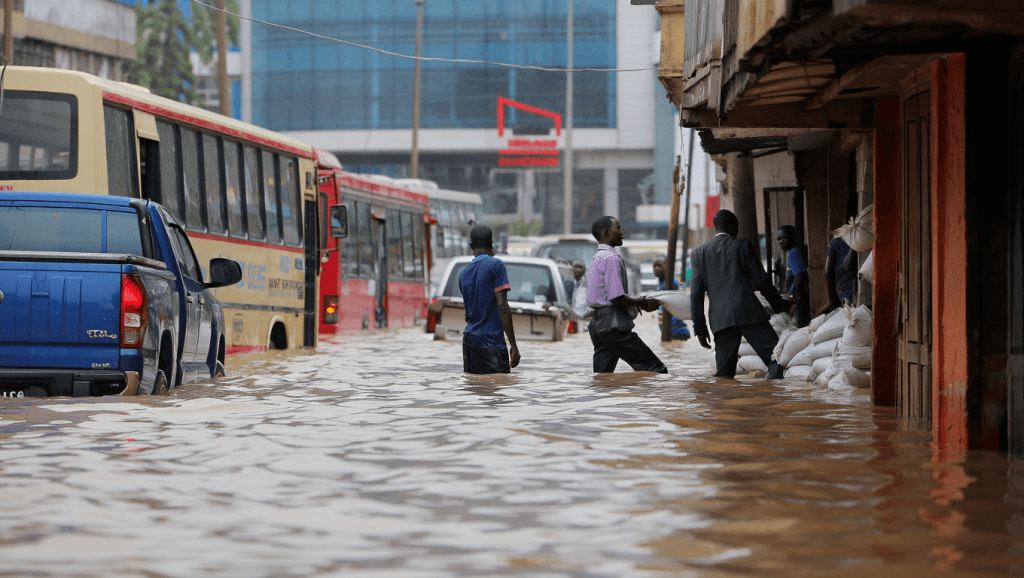
As the flash floods have become a perennial problem, there is a pressing demand for specific planning, preparedness and quick responses to the impact of the problem.
I have just been to my home village in Mityana, 70 kilometres West of Kampala.
The extreme heat of February dried up many maize fields.
Currently, the frequent rains mean impassable roads and have laid waste to some of the crops.
By simple observation, while growing up our fields used to have trees as boundary trees or hedges. Trees like Calliandra( Kaliisambuzi), Grevillea Robusta, Albizzia( Mugavu).

In the banana and coffee gardens there were always Mituba trees (used for making bark cloth) and others to provide shade and to support climbers like yams and passion fruit. Mituba trees also provided fodder for the goats.
Others included mangoes and Mivule(African teak)trees. They served as windbreaks- reducing the speed of strong winds and minimizing the soil erosion and crop damage. When pruned, the wood was used for cooking or building simple structures on the farm.
Some of them had medicinal purposes and others improved soil fertility by the bacteria in their roots fixing nitrogen for the crops.
Most fields I pass by are in the open, all trees cleared; rendering the land and crops vulnerable to floods and strong winds.
Farmers should be encouraged to plant indigenous windbreaks like Mugavu, Kaliisambuzi, Mukoge as hedges or boundary trees.
I can recall visiting my sisters in South England in October 1987. On the night of 15-16 October, we were woken up by howling winds followed by heavy rains, power went off and we feared for our lives. There had been no warning of this severe weather event.
Early the next morning, peeking through the kitchen window we could see huge trees uprooted all around us.
When power was restored, we learned that South England had suffered the worst storm since 1703 and the damage was estimated to be a billion pounds! It took several weeks to clear the fallen trees. 15 million trees were destroyed, a number of them were a hundred years old and 18 people had died.
The UK MET office had missed the storm and at the same time, there was no way of warning the people about the severe storm.
After the storm , 500 million trees were planted and this time , trees with broad- based leaves were preferred to the pines and other conifers that made up the majority of those destroyed.
Among the lessons learned was the setting up of a National Severe Weather Warning Service to improve the quality of weather forecasts and to improve preparedness and response to the likely impact. Technology has also improved the quality of the forecasts.
Uganda and all countries have to devise locally appropriate strategies to reduce the main human activities that increase global warming and involve the people at the grass roots in campaigns for tree planting and adopting clean energy.
My geography teacher’s voice still echoes: The higher you go, the colder it gets- for every 1000m climb, the temperature drops by 6.5 degrees Celsius.
Kigezi region 490 Kilometres South West of Kampala of altitude 1200-2000 metres above the sea level, has been the coldest region of Uganda. Mgahinga Gorilla National Park between 2,227-4,127 metres above sea level has average temperatures of 20 degrees Celsius during the day while night time temperatures can drop to around 9 degrees Celsius!
In the 60s and 70s Kigezi region had an average temperature of 15-18 degrees Celsius. Currently it’s getting warmer due to deforestation and population pressure.
Kampala city at an altitude of about 1190 metres above sea level has an average daytime temperature 26-28 Celsius and 16 degrees in the evening. During the February heat wave, temperatures as high as 34 degrees Celsius were recorded in Kampala by the Uganda National Meteorology Authority.
In the 60s and 70s, Kampala’s daytime temperatures ranged from 21- 23 degrees Celsius.
For now, due to global warming, the rains are wreaking havoc in both the cities and villages and the ordinary people are the worst impacted. More collective efforts and actions are demanded from everyone, everywhere to protect, save and preserve the environment.
“ The truth is : the natural world is changing. And we are totally dependent on that world. It provides our food, water and air. It is the most precious thing we have and we need to defend it.’’ – Sir. David Attenborough (world environmentalist and climate activist)
QUESTION:
How are you participating actively in stopping the polluting of the environment in your community?
A clean, safe environment starts with you and I.
 apagefrommunakusbook