A TRIBUTE TO HON. MARY BUSINGYE KAROORO OKURUT( 08/12/54- 11/08/25)

The late Mary Busingye Karooro Okurut was born in Bushenyi district in western Uganda. Her father was a headmaster of one of the primary schools of the area. After her A-levels in Trinity College Nabbingo , she joined the only country’s university then , Makerere, for a BA literature degree then pursued a MA degree in literature soon after.  In 1981, she then joined Makerere university’s department of literature as a lecturer. Later, she went on to work with the education commission and the Presidential Press unit. From 2004 to 2021, she entered active politics and represented Bushenyi district as the Women’s Member of Parliament. On losing this seat in 2021, she was appointed a presidential advisor in media and public affairs.

Undeniably, Hon. Mary Busingye Karooro Okurut is considered as one of Uganda’s distinguished educationists, author and politician. Our paths would never have crossed if I had not had an inherent passion for the written word which drove me to awaken the sleeping writer in me.  I had shelved her during my long dance with motherhood and career development. As my children started joining university one by one, I willed myself to pick up the creative side of myself. After my return from economic exile I met Hon. Mary Karooro Okurut often in the Femrite- organised workshops, seminars and retreats. It was both a privilege and exciting to know her. For her, literature was essential in cultivating and enhancing critical thinking, empathy, helping people to see different perspectives of each situation and developing good communication skills.

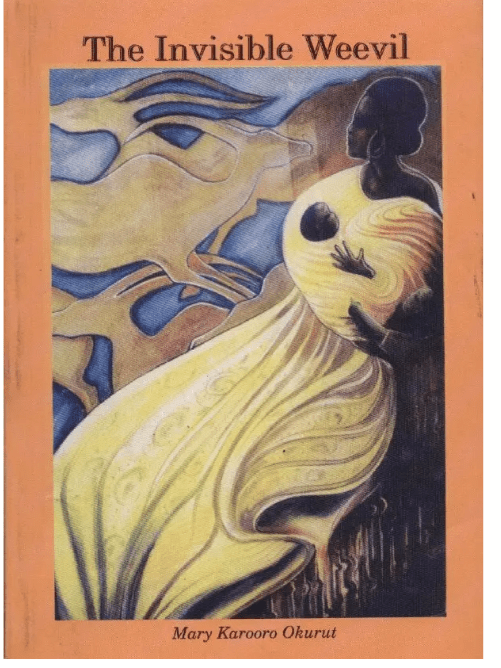
As a voracious reader, I had read and been fascinated by her novel : The Invisible Weevil ( 1998) –fiction based on the post-colonial period of Uganda’s history while drawing attention to the political instability and gender concerns of the day.

And the drama one : The Curse of the of The Sacred Cow; talking about the misfortunes that befell  the household after they had tampered with the values and beliefs within their culture.

 Later, I also came across: A Woman’s Voice – an anthology of twelve short stories told by different women in Uganda, which she had edited and was published by Femrite Publication Limited in 1998. It documents women’s feelings, thoughts and experiences.

 Currently, her  books are taught in secondary schools and tertiary institutions.

As a lecturer in the department of Literature  of Makerere University Kampala , she was distinctly aware of the absence of Ugandan female writers in the literary  landscape of  Uganda and globally and yet the written word could be as sharp as swords.

She knew that if the Ugandan women were empowered and encouraged to write their stories in their own words, these stories would help shape public opinion and inspire advocacy for gender equality. Such stories usually based on the reality on the ground would also promote women’s education and cause social reform movements  about important social issues like identity, relationships, inheritance , dowry and child marriages. Women make up more than fifty percent of our population and still remain the backbone of families and communities in Uganda. They are natural storytellers and custodians of oral narratives. This demands that women’s voices be consistently heard and celebrated.

Driven by her passion for literature, her curiosity, bold confidence, determination and nurturing spirit,

Hon. Mary Karooro Okurut  and a few other like- minded women : Ayeta Anne Wangusa, Hilda  J. Twongyeirwe, Rosemary Kyarimpa and Dr. Susan  N. Kiguli,  co-founded the Uganda Women Writers Association : FEMRITE in 1995 and launched it in 1996.

Since then, this sound Platform and launching pad, has supported Ugandan women writers and given them a collective voice as they told their unique stories which themselves became works of catalysts of change addressing collective concerns or overlooked realities.

Having been in economic exile for over twenty five years, I returned to a completely changed literary landscape; no longer male-dominated. We now boast of international writers and poets. In 2007, Monica Arac de Nyeko became the first  Ugandan to win the prestigious Caine Prize for African writing  for her story Jambula Tree. Other outstanding  international writers include: Goretti Kyomuhendo,

Sarah Kiguli, Glaydah Namukasa and many young ones are emerging during this digital era. We also have publishers , editors and bloggers.

The once- silent women are now vocal

The once – unseen are clearly visible and recognised

The unheard are now being listened to attentively.

They are all offering transformative ideas for creating a world that values men and women equally.

They never forget their biggest challenge of consistently creating and nurturing  a reading culture in each generation.

“ A candle loses nothing by lighting another candle.’’– James Keller

Their pens and keyboards are at work 24/7.

All this credit first goes back to God who gave these women the gifts and talents of playing with words to create powerful images.

 And then to ‘’ Mother hen, Mary Busingye Karooro Okurut, the storyteller from Bushenyi and all the teams she has worked with at FEMRITE for these 29 years of active service.

In the last three years, efforts are also being invested into FEMRITE owning its own home/base: A key Rite of Passage at 29 years of age!  In our culture this symbolises maturity, taking on greater responsibility, self-provisioning and Independence.

Thank you most sincerely, Mother hen for ensuring that there is continuity after you. Uganda’s women writers are determined to honour you by carrying on your established legacy in the literary world while creating their own as well.

As Albert Einstein rightly said : “ Creating is contagious , pass it on.’’

Creative works are gifts to the world; like all other authors before you, yours will outlive you and you will be reborn as each generation reads and interprets them.

REST IN ETERNAL PEACE 

Mother hen of FEMRITE

YOU WIN SOME AND LOSE SOME


Caption: My high school netball team, waiting to take on another school’s team on home ground in the late 60s.

I have always been keen to watch the Wimbledon tennis championships, especially the semi-finals and finals for both male and female competitors.

On Saturday , 12th July 2025, I sat glued to the TV watching the 57 minute final  match between  the  23 year old Amanda Anisimova of USA and 24 year old Iga Swiatek of Poland. Both of them were playing for the first time in  the final of a Grand Slam at Wimbledon.  The fans remained quiet and still as they watched Swiatek outperform  Anisimova who was expected to win. But then that is the beauty of  a competitive game , you cannot know the actual winner until the game has ended. Each player has to keep offering her best and play fairly to be a deserving winner.

Swiatek offered her best  and won while Anisimova after the match admitted having  been slow in movement  and frozen for some moments due to the pressure put on her by Swiatek.

There is always life after the game. Anisimova has to do  a rebuilding job to come back on top.

 “I never lose; I either win or learn.’’-  Nelson Mandela.

What has always defined  a fighter is how well he/she rises after falling.

Then by sheer chance on the 22nd July 2025, I stumbled on the 13th edition of the Women’s Africa Cup  of Nations  semi-finals at the Olympic stadium, in  Rabat,  Morocco. Eventual tournament winners Nigeria were playing against South Africa and Nigeria won  2 to 1. 

These two games took me back to my childhood and I reflected on the timeless lessons I had learned as a member of my high school relay team and long jumper, lessons that I could never have been taught in any class, and I greatly appreciate how they have guided me through my life’s journey.

Whether playing on your own or as a team , you enter the competition to win but at the back of your mind you know very well that losing is the other side of the same coin. You have to seize  the opportunity to be a deserving winner. You can come from behind and win ; the game is never over until the final whistle is blown.

In the tennis singles you are playing  on your own but in the football team you are an integral part of the  team and the success of the team depends on how well each member performs her/ his part.

Singles

  1. Preparations: practice makes perfect. The more you play, the better you become. 

Mentally- The game starts in your mind by planning and strategizing on how to achieve your goals. You anticipate your opponent’s moves.

When you are on the field or court , your mind should be at work

Focus on the whole process, not the outcome only. What you focus on grows.

Self motivation by positive self-talk to encourage yourself goes a long way.

Handling success and failure

Harness the lessons you learn from failure –  You cannot blame anyone for your loss. Learn from your mistakes and use the lessons and experiences to improve your personal best.

 As time goes by, you have to listen to your body to decide when to call it a day. Two of the greatest tennis players of all time left us still applauding. Martina Navratilova who turned professional aged 18 in 1977 stopped playing singles in 1994 but continued with mixed doubles till she was almost aged 50 in 2006.

Serena Williams turned professional aged 14 in 1995, played her last game aged 40 in 2022 with 23 grand slams under her belt. 

In 2023, Anisimova chose to take an eight month break from the demanding tennis schedule due to mental health challenges.

 She came back when she felt that she had regained her mental strength. 

                Team games require all that is demanded of you when playing as an individual plus factoring in         and accommodating and tolerating the weakness and strengths of the members of your team.

Teamwork – Synergy:  Each member should give her\his best towards each moment of the game to amplify the final outcome.

Discipline- success demands dedication, consistent effort, adherence to the training schedule and game plans.

Resilience and perseverance help everyone to overcome challenges and to be able to bounce back from losses; something that  will  carry them through life.

Communication skills- verbal or just by body language to communicate quickly. It demands listening and good eye contact. 

Responsibility and accountability – each player is responsible for her/his behaviour on and off the field including keeping in top shape . 

              Leadership- good leadership guides and motivates the team mates.

Time management- has to be learned over time to enable all players to balance training, games and personal life.

Humility- keeps you open –minded to keep learning from others and your own experiences.

       “ The only true wisdom is  in knowing  you know nothing.’’ – Socrates.

                 Sports builds character and should be integrated into school activities.

I know for sure that a good balance of losing and winning in games and in life in general, keeps you on your toes; never to take things for granted. You learn to persevere, eventually becoming resilient enough to adapt to changing circumstances.

                 How the psychologists interpret  the Win some, Lose some mantra:

  • They tell us that in sports and in the journey of life, winning and losing some is a natural cycle of success.

It is not possible to win all the time- both losing and winning are equally important as one grows into the best player.

  • They advise us not to allow ourselves to be defined by the loss or failure nor take winning for granted.
  • They remind us that winning keeps pressure on you to stay at the top.

Be humble in victory and graceful in defeat – Circumstances keep changing : Today’s winner may be tomorrow’s loser.

Being humble in victory prevents arrogance and energizes one to learn from success. Grace in defeat promotes resilience and healthy coping mechanisms. You accept defeat other than deny it, opening yourself up to learn from your mistakes and bounce back from setbacks.

  • They emphasize to us that in the grand scheme of things: life,  setbacks are inevitable and should always be accepted.

We learn more from our failures than in victory. Take time to reflect on why you lost and use it in planning how to play better in future. You can always bounce back from challenges. 

 In today’s world of sponsorship and social media, it is important that each player is equipped with guidelines of handling pressure- the training and competitions by themselves exert a lot of pressure on the players but the fans and followers can overwhelm the players .

If you have learned how to handle winning and losing, sometimes you find yourself comfortable with the loss- you were fully prepared for the game, were focused to be fully present and gave it your all. It only happens when you have developed the mental toughness to be the best.

Parents and teachers should consistently teach children and prepare them on how to deal with both. This will help them navigate through today’s highly competitive world. At all levels in life, you can experience either but what matters most is how you deal with each one. Life will always go on whether you win or lose. At the same time remember that shallow victories leave a hollow echo.

Question:

 Is there a time in your life when you found it terribly difficult to accept loss or defeat?

How did you pick yourself up from this situation?