A TRIBUTE TO HON. MARY BUSINGYE KAROORO OKURUT( 08/12/54- 11/08/25)

The late Mary Busingye Karooro Okurut was born in Bushenyi district in western Uganda. Her father was a headmaster of one of the primary schools of the area. After her A-levels in Trinity College Nabbingo , she joined the only country’s university then , Makerere, for a BA literature degree then pursued a MA degree in literature soon after.  In 1981, she then joined Makerere university’s department of literature as a lecturer. Later, she went on to work with the education commission and the Presidential Press unit. From 2004 to 2021, she entered active politics and represented Bushenyi district as the Women’s Member of Parliament. On losing this seat in 2021, she was appointed a presidential advisor in media and public affairs.

Undeniably, Hon. Mary Busingye Karooro Okurut is considered as one of Uganda’s distinguished educationists, author and politician. Our paths would never have crossed if I had not had an inherent passion for the written word which drove me to awaken the sleeping writer in me.  I had shelved her during my long dance with motherhood and career development. As my children started joining university one by one, I willed myself to pick up the creative side of myself. After my return from economic exile I met Hon. Mary Karooro Okurut often in the Femrite- organised workshops, seminars and retreats. It was both a privilege and exciting to know her. For her, literature was essential in cultivating and enhancing critical thinking, empathy, helping people to see different perspectives of each situation and developing good communication skills.

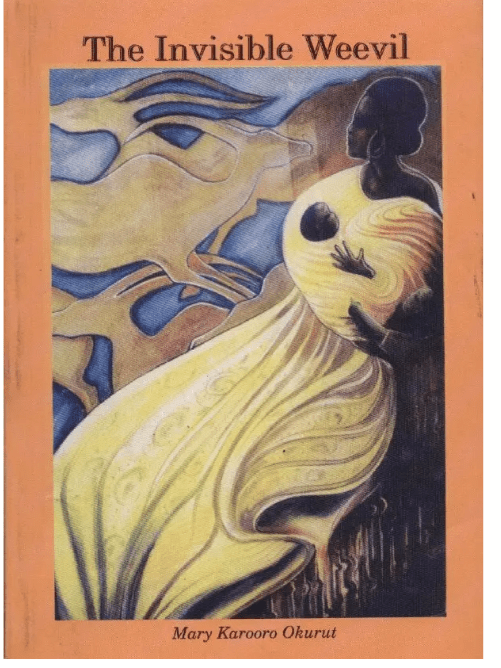
As a voracious reader, I had read and been fascinated by her novel : The Invisible Weevil ( 1998) –fiction based on the post-colonial period of Uganda’s history while drawing attention to the political instability and gender concerns of the day.

And the drama one : The Curse of the of The Sacred Cow; talking about the misfortunes that befell  the household after they had tampered with the values and beliefs within their culture.

 Later, I also came across: A Woman’s Voice – an anthology of twelve short stories told by different women in Uganda, which she had edited and was published by Femrite Publication Limited in 1998. It documents women’s feelings, thoughts and experiences.

 Currently, her  books are taught in secondary schools and tertiary institutions.

As a lecturer in the department of Literature  of Makerere University Kampala , she was distinctly aware of the absence of Ugandan female writers in the literary  landscape of  Uganda and globally and yet the written word could be as sharp as swords.

She knew that if the Ugandan women were empowered and encouraged to write their stories in their own words, these stories would help shape public opinion and inspire advocacy for gender equality. Such stories usually based on the reality on the ground would also promote women’s education and cause social reform movements  about important social issues like identity, relationships, inheritance , dowry and child marriages. Women make up more than fifty percent of our population and still remain the backbone of families and communities in Uganda. They are natural storytellers and custodians of oral narratives. This demands that women’s voices be consistently heard and celebrated.

Driven by her passion for literature, her curiosity, bold confidence, determination and nurturing spirit,

Hon. Mary Karooro Okurut  and a few other like- minded women : Ayeta Anne Wangusa, Hilda  J. Twongyeirwe, Rosemary Kyarimpa and Dr. Susan  N. Kiguli,  co-founded the Uganda Women Writers Association : FEMRITE in 1995 and launched it in 1996.

Since then, this sound Platform and launching pad, has supported Ugandan women writers and given them a collective voice as they told their unique stories which themselves became works of catalysts of change addressing collective concerns or overlooked realities.

Having been in economic exile for over twenty five years, I returned to a completely changed literary landscape; no longer male-dominated. We now boast of international writers and poets. In 2007, Monica Arac de Nyeko became the first  Ugandan to win the prestigious Caine Prize for African writing  for her story Jambula Tree. Other outstanding  international writers include: Goretti Kyomuhendo,

Sarah Kiguli, Glaydah Namukasa and many young ones are emerging during this digital era. We also have publishers , editors and bloggers.

The once- silent women are now vocal

The once – unseen are clearly visible and recognised

The unheard are now being listened to attentively.

They are all offering transformative ideas for creating a world that values men and women equally.

They never forget their biggest challenge of consistently creating and nurturing  a reading culture in each generation.

“ A candle loses nothing by lighting another candle.’’– James Keller

Their pens and keyboards are at work 24/7.

All this credit first goes back to God who gave these women the gifts and talents of playing with words to create powerful images.

 And then to ‘’ Mother hen, Mary Busingye Karooro Okurut, the storyteller from Bushenyi and all the teams she has worked with at FEMRITE for these 29 years of active service.

In the last three years, efforts are also being invested into FEMRITE owning its own home/base: A key Rite of Passage at 29 years of age!  In our culture this symbolises maturity, taking on greater responsibility, self-provisioning and Independence.

Thank you most sincerely, Mother hen for ensuring that there is continuity after you. Uganda’s women writers are determined to honour you by carrying on your established legacy in the literary world while creating their own as well.

As Albert Einstein rightly said : “ Creating is contagious , pass it on.’’

Creative works are gifts to the world; like all other authors before you, yours will outlive you and you will be reborn as each generation reads and interprets them.

REST IN ETERNAL PEACE 

Mother hen of FEMRITE

                             WALKING WITH ONE’S PAST

                             WALKING WITH ONE’S PAST

There are many old adages about the past, present and future- the standard markers of

 of time.

The past is behind, learn from it . The future is ahead, prepare for it . The present is here, live it.’’- Thomas  S. Monson

None of us can change the yesterdays, but  all of us can change our tomorrows.’’– Colin Powell

Tomorrow is often the busiest day of the week. – Spanish Proverb

One thing I know for sure is that as l live in the present moment, the past keeps showing up in snippets.

The psychologists tell us that unresolved issues in our past keep showing up and influencing the decisions and choices we make as adults.

The historians want us to look at everything through the lens of history since humans hardly change in behaviour and history helps us understand the complexities of human behaviour.

Looking at the past gives you perspective- understanding the complex circumstances of past events. It endows you with a broader perspective on current issues and challenges. It influences you to make better decisions and develop more effective solutions to the present.

Studying history helps each one of us to understand our own identities and cultures.

For the young generation, history presents them with real life dilemma, teaches them how to understand what it takes to overcome adversity and make a difference in the world around them. Students learn that acts of love, sacrifice, perseverance, integrity and commitment can impact the lives of many and inspire future generations to be bold and daring.

For the elderly, history helps us understand who we are, where we come from and the values that guide us. History adds depth to our present understanding and enhances senior identity.

In medicine, the health history is very crucial in understanding the patient’s state of health and most times it has a role in the diagnosis and management of each patient. Past medical history is essential in making timely and accurate diagnosis of an acute illness and leads to improved outcomes. It also helps in identifying the high risk of having common disorders and in the management of present health care and future needs of each patient.

In the current Digital era where things change often and rapidly, individuals and companies have to keep updating their profiles, systems and skills to survive and thrive.

For regular bloggers like me, we are to keep agile by writing content which is fresh , original  and relevant to keep our readers engaged and to attract new ones to our websites while retaining the old ones. Regular update is essential as new information becomes available and the writers gain new insights. Old content can also be refreshed.

 We should not to dwell in the past but we must strive to understand it with clarity and pick what is most appropriate to inform our Present and Future. For you when you know and understand things, you act better.

Those that fail to learn from history are doomed to repeat it.’’– Winston Churchill

 THE BOOK LAUNCH

An important historical event in the advance to Uganda’s independence took place in the six hundred years old Buganda Kingdom located in the current central Uganda. By then, it was being ruled by its 35th King: Kabaka Edward Mutesa II.

In 1945, after the second world war, the British empire and European countries were weakened by debts and needed to shed off some of their colonies and territories. The war armed the Africans with the military knowledge and leadership skills which they later used to fight for their own independence. African nationalism challenged the colonial powers and dismantled the empires.

By the time the British Prime Minister,  Harold Macmillan made his famous speech of “ the Wind of Change’’ in Cape Town , South Africa, in February 1960, the forces of change were blowing furiously across the African Continent.

From July 1953,  Kabaka Edward Mutesa II and his people had started clamouring for independence as a sovereign state from the her Majesty’s government.  The stalemate between the Kabaka and Queen’s representative as governor of the Uganda Protectorate, culminated in the exile of Kabaka Mutesa II to Britain on 30th November 1953. This was followed by two and half years of uncertainty and non-violent struggle against the Queen’s government by the Baganda.

Kabaka Mutesa II’s government was run by 3 Ministers: 2 Protestants and 1 Catholic. Among the  Protestants ones was my late father Paulo Neil Kavuma as the Katikkiro- Chief Minister. Educated in a Church missionary –founded school for chiefs followed by 20 years of working  in the Protectorate’s Provincial  and Resident’s Offices and 12 years as a saza chief in the Buganda Kingdom: he found  himself at the helm of the government.

 After the deposition of the Kabaka, the three ministers accepted to become regents – to rule the kingdom on behalf the Kabaka until his return. Together with their people, they chose to fight non-violently and relentlessly until the Queen’s government agreed to return Kabaka Mutesa II as their king on 17th October 1955.

It was a win-win situation for the Kabaka and his people and the Uganda Protectorate representing the Queen’s government in that for once the Buganda Kingdom agreed to become an integral part of the Unitary state of Uganda while Her Majesty’s government agreed to return Kabaka Mutesa II as Kabaka immediately and sign the new 1955 Buganda Agreement.

CRISIS IN BUGANDA 1953-55 is a personal account of my father as Katikkiro  at the vanguard of the fight for the return of Kabaka.  He wrote the manuscript in 1957 when everything was still fresh in his mind and it was published by Rex Collings, London 1979.

 Due to the civil turmoil  in the Uganda of the 80s, only a few copies were made available in Uganda.

Fast forward to the new millennium when our three children and a niece who were attending the University of Cape Town in science courses but voracious readers, stumbled upon CRISIS IN BUGANDA 1953- 55 in the African Region History section of their main library in 2007.  This challenged me as the eldest daughter of my father, to make the book available to Ugandans and the world at large.

 On returning to Uganda after almost twenty five years of economic exile in Botswana, Southern Africa,  I started on this project only to be slowed down by the two half years of the COVID-19 pandemic lock down. It took me a while to get assimilated into a radically changed Uganda.

By God’s grace , the 2024 Edition of the CRISIS IN BUGANDA 1953-55 was successfully launched at the very place: Butikkiro- the official residence of the Katikkiro of Buganda, where my late father had lived during that tough period of the exile of the Kabaka. By sheer coincidence, it was exactly 71 years since the historical event had happened! A group of invited guests closely connected to the book , members of our big family and friends were hosted for the launch by none other than the current Katikkiro of the Buganda kingdom: Owekitiibwa Charles Peter Mayiga.

The theme of the day was : Only Time Will Tell – that’s why my father wrote the book so that readers get to know the facts surrounding the saga to decide for themselves whether the 3 ministers led by him as Chief Minister made the right decisions at that moment in time.

THE  2024  EDITION INCLUDES

  1. The original book as my father wrote it and had it published in 1979.
  2.  Part of the Post Script is an introduction to the new edition by a renowned Ugandan Historian : Prof of History , Samwiri Lwanga- Lunyiigo
  3. A chapter entitled : After the Crisis in Mengo– introducing the young generation to Paulo Neil Kavuma and highlighting his great contribution to the growth and development of Uganda including his indispensable role in the NRA bush war in the Luwero triangle( 1980-86) and last but not least as a hands-on- father and as the true portrait of voluntary service in Uganda during his final thirty four years after the Mengo Crisis of 1953-55.

He died with a great sense of radical thankfulness and celebration of his whole life.

“ The dying pray at the last not ‘please’ but ‘ thank you’ as  a guest thanks his host at the door.’’

REVIEWS- One encouraging review from a reader under 40 :

“I finished reading Crisis in Buganda 1953-55 on Sunday.

What a thrilling book!

I was so engrossed in reading that book and found it most eye-opening and informative.

May your father’s legacy live on.’’

Where can I get the 2024 Edition of the book?

Locally:  Contact

+ 256 705164655 and + 256 784 859 642

For those outside Uganda and are interested in buying copies of the book please contact me via email address: janekavuma.kayonga@gmail.com

A tree without roots is a  piece of wood.- African proverb.

“ We are because he was.’’  He remains our best role model.