GIFT GIVING DURING THE FESTIVE SEASON

A traditional Christmas tree with the Star of Bethlehem at the top. It was decorated by my daughter and her four years old daughter.

I am a Christian who believes in Jesus Christ, the Son of God. When we had sinned and separated ourselves from God, our Father, Jesus was called by the Spirit of the Lord to put us right with God.
This was born out of God’s love, mercy and faithfulness to us.
John 3:16 reads : For God loved the world so much that he gave his only Son, so that everyone who believes in him may not die but have eternal life.
It is this great love and sacrifice that should not be lost in the hustles and bustles of the Christmas season.
After the shepherds, the three wise men from the east, were the second group of people to look for Jesus in the town of Bethlehem in Judea guided by the star in the east. They presented the baby Jesus with gifts of gold, frankincense and myrrh. The gift giving of Christmas is linked to the spirit of giving gladly.

Giving to those in need is considered as an act worship of God. God delights in doing good things for us so we should also find great pleasure in giving to others every day, throughout the 365 days not just at Christmas time. God loves a cheerful giver.
My favourite quote about giving says: “You give but little when you give of your possessions. It is when you give of yourself that you truly give.’’- Kahlil Gibran

It is good to know that at Xmas time, the world shares the thought of giving and sharing which itself reflects caring about others.
I have celebrated more than sixty-five Christmases and as I look back, I realise that getting the right gift to the right person changes as one grows older and what he/she considers most important in life changes.
When I was under 12 years old, my perfect gifts for the season were dresses, shoes, dolls, books and sweets and cakes.
As a teenager, it was about the trendy wear of the day, a book and some Quality Street Assorted Chocolates Sweets!
30s-40s – Something that could add real value to me. Something I could use over and over again like a pair of golden ear rings or an African beads necklace.
50-60 – Something that increased my joy, fun and trust of the human being. It varied simply from spending quality time with loved ones, what makes me feel alive and special, opportunities to contribute to the well- being of others and guiding others into helping themselves and reaching their full potential.
65+ The wisdom of Age has taught me that the secret of living is giving and that non- economic ways of giving to others in the form of presence, attention, encouragement and compliments are more fulfilling to the giver than bought gifts.
Acts 20:35 reads: It is more blessed to give than to receive. We live in an era of consumerism and most of us have become addicted to the emotional boost of buying something new. Simply collecting goods and material possessions. In the process we may forget those in need.
Giving the right Gift.
I can vividly recall the smiles on my face when I was given what I really wanted at that moment in time. Not forgetting that each gift represented love, hope and kindness of the giver.
Giving the right gift involves listening and observing to know the needs, desires and wishes of the receiver. Mothers are endowed with this intuition!
After all, giving gladly has mutual benefits; : it enriches the receiver and the donor. It nurtures and enriches our relationships.
If you’re not making someone else’s life better, then you’re wasting your time.’’ – Will Smith.

Research in human behaviour by the psychologists proves that giving others gladly makes us happy. Using Brain Imaging, it shows that both giving gifts and receiving gifts activates core areas of our brains associated with reward and pleasure. When these areas are activated, they release the ‘feel good chemicals like Serotonin and Dopamine which give us a sense of pleasure. This explains why we feel good when we give to others.
Most times, we are motivated to give to others without expecting anything back out of empathy, compassion, love and humility.
“It’s not how much we give, but how much love we put into giving.’’- Mother Teresa.

Love is action; it has to be expressed in small acts of kindness that add up to build the big picture- caring about a person. The receiver feels that he/she matters.
For a true believer in Christ, faith is expressed in actions done with love, for love and in love.

Toxic Giving.
Like all human interactions, giving can be abused. Some people who want to control and manipulate others in abusive relationships use gifts.
Some charity organisations can also offer toxic charity to the poor by giving them what they can gain by their own initiative. The giver focuses on the rewards other than the benefits received by the served. In the process they turn the poor into dependants on the charity.

When we do for those in need what they have capacity to do for themselves, we disempower them.’’ – Robert d. Lupton

Having received gifts from my parents for many years and learned to give generously to my children who are now giving to their children and myself I am reminded with absolute clarity of the greatest gift which parents can give to their children.
As a child, I remember being told by my parents that the greatest gift they could give me could never be bought from a toy shop or wrapped up into a box. That gift was how they were to live their lives as role models to me. By doing exactly what they wanted me to do and be, they inspired and empowered me to be principled , authentic and a decent human being. I will remain for ever grateful to them for liberating me to be myself: authentically happy, fulfilled, whole and always wanting to be more and do more for myself others.
I never understood what they meant until many years later when as a medical student, I spent three months in training about mental illnesses and their causes, at the national mental hospital then.
That experience revealed to me how the relationships with children and their parents had a lasting effect on the children’s relationships with themselves and other people. The parents’ influence always remains present in the conscious or unconscious level. When parents live their lives as models of honesty, integrity, authentic while acknowledging their flaws as human beings, it empowers their children to live their own lives in their own rights. They learn some coping mechanisms from their parents and learn to find moment –by-moment delight in daily life. It attracts like-minded people towards them. Their parents set them free to be their own authority in adulthood.
When parents fail to live out their lives as role models to their children, the parents’ unlived life of abandoned dreams, unrealised values, incomplete realisation of their life’ s vision, leaves their children in misery and suffering. They are closed up to the full creative expression of who they can truly be. Such awkward moments cause anxiety and depression which may last long.

Looking back at my life, I am grateful that after a loving and supportive family, I have always had some genuine and loyal friends who are always willing to do things for me, gift me and my children with presents and time. Amazingly, they are now extending their gift giving to my grandchildren! Thankfully, I have always intentionally endeavoured to give of my time, efforts, energy and resources to them too.
As the Baganda say: Generosity extended to my children and grandchildren is as good as generosity extended to me.
I will always remain grateful to these loyal friends.

My culture has some rich proverbs to encourage generosity among ourselves:
Akatono Okalya nemunno. Loosely translated: Even the little in your hands, can be shared with a friend.
Ekiisa ekitagaana kizaala obulimba: Saying “yes’’ to everything breeds lies.
Entasiima ebula agiwa : A luck of gratitude burns up your blessings.
Alinda biwere alisanga nnyina afudde : If you want to build up your reserves, to gift your mother she will die waiting.

OTHER QUOTES ABOUT GIVING
2 Corinthians 9:7 : You should each give, then, as you have decided, not with regret or out of a sense of duty; for God loves the one who gives gladly.
Remember that the happiest people are not those getting more, but those giving more.’’- unknown
Alone we can do so little ; together we can do so much more.’’ Helen Keller
“ No one has ever become poor by giving.’’- Anne Frank
We make a living by what we get. We make a life by what we give.’’ Winston Churchill
“I have found that among its other benefits, giving liberates the soul of the giver.’’ -Maya Angelou
“It’s every man’s objective to put back into the world at least the equivalent of what he takes out of it.’’ - Albert Einstein

As you look around for the perfect gift at any particular occasion, consider the needs, desires and wishes of the receiver
This Xmas do not allow the original meaning of the Xmas message of sacrifice and giving be lost in the merry making.
The two years of the COVID-19 pandemic lockdown crystallised to all of us what is most important in our lives namely: Life itself and nurturing and staying connected to deep, healthy relationships – family and friends.

My dear followers, readers, family and friends thank you for walking with me along this long journey of becoming an outstanding writer and making the world a better place in my small way.
Without your support, I would have made just a few baby’s steps but you and I have been able to walk far since I started this Blog in October 2016.
Thank you very much for your unwavering support and feedback.
Wishing you a Merry Xmas and year filled with love, peace, joy, good health and wealth.
Jane Nannono.
WHAT I HAVE BEEN READING LATELY

Ngugi wa Thiong’o  is considered to be East Africa’s leading novelist. 

By sheer coincidence, he is a graduate of Makerere University College of the early 60s and has been writing since then.

His first novel: Weep Not Child was published in May 1964 !

Like in any other industry, writers grow over time; maturing to become society’s influencers and catalysts of change.

A book or a short story that a writer writes and publishes at a particular moment in time, reflects the overall maturity of that person and how he/she interprets society at that moment. One good reason to keep writing.

As Ngugi wa Thiong’o clearly puts it in these quotations:

Write write write again , and you will get it right.’’ In short: write and write makes it right.

“All that mankind has done, thought, gained or been; it is lying as in magic preservation in the pages of books.’’

Writing is a skill that requires a tremendous amount of practice to become the best of the best.

 The writer Malcom Gladwell popularised the 10,000-hour rule of guided practice for anyone to become a master of a skill. 

I have been running a personal blog since 2016; to hone my writing skills, to build up a readership base and to connect with writers. I use my wealth of knowledge, skills and experiences to impact readers in my small way. Getting feedbacks from writing groups and readers has helped me tremendously to grow as a writer.

I attend writing workshops and conferences in my quest to become a master. Last week I attended a three days’ international conference to celebrate Abdulrazak Gurnah as the first East African writer to win the Nobel Literature Prize (2021).  It was organised by the Uganda Women Writers’ Association- FEMRITE, founded in 1995.

I consistently take part in writing competitions like the Commonwealth short story competition. It pushes me to write to a wider, diversified audience. It takes me out of my comfort zone.

I am a member of several Online writing cartels like The Write Practice, Yours2 Read and Two Drops of Ink. It has enabled me to connect with other writers worldwide.

I write short stories in between larger projects. It has helped me develop my own style.  Writing Short stories forces me to focus on writing clearly and consistently.  I am becoming a better writer. Writing has now become a practice to me. 

Flipping the coin, any writer who wants to acquire literary excellence has to become an avid reader.

 I consider consistent reading and writing as inseparable Siamese twins.

I read books by different authors and of different genres.

Reading expands my vocabulary and imagination widely. The more I read, the easier it becomes for me to create believable characters, to edit my writing pieces and enhance them. It also encourages me to take more risks in writing.

I gain valuable knowledge from each book I read and this is how I was turned into a global citizen long before the invention of the Internet.              

The more I read, the more remarkable I write.

I regularly read medical journals to keep abreast with new advances in medicine and science.

This is what I have been reading lately:

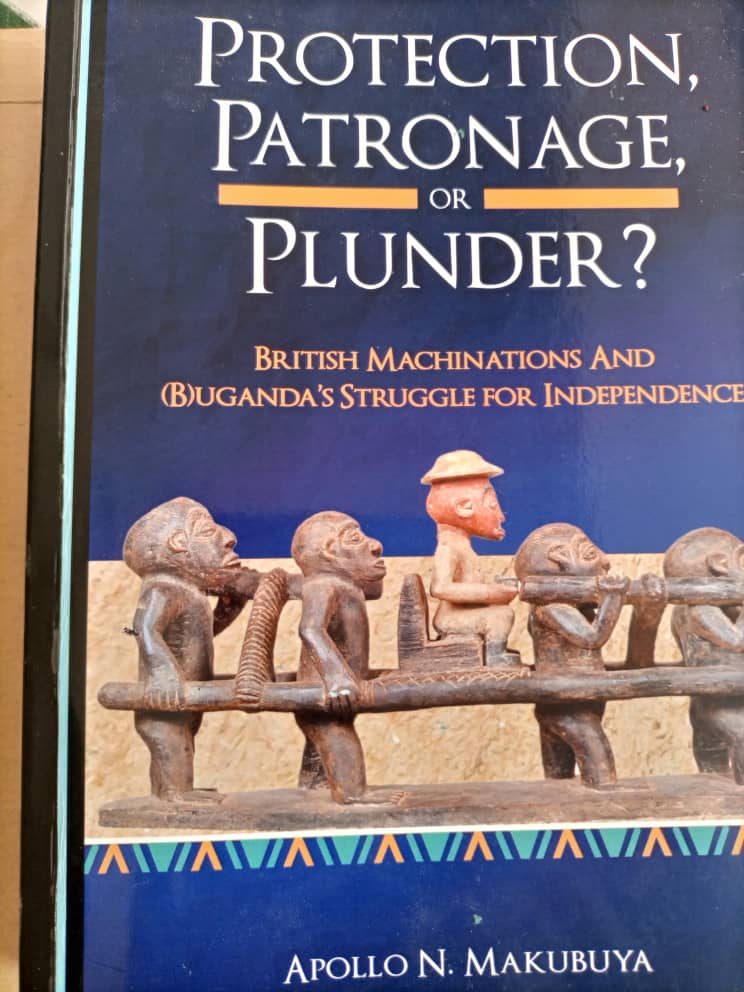
Protection, Patronage , or Plunder? British Machinations and (B)uganda’s Struggle for Independence by Apollo N. Makubuya

This is a huge book but very essential book that dissects the history of Uganda as a British protectorate for sixty-eight years and beyond. I chose to read it slowly and it took me three months to complete but it was worth the time and effort. What makes it unique is that the writer, a lawyer by profession, had access to declassified records that had been kept under lock and key in UK for over fifty years. Close to  our independence in 1962, many historical documents were shredded and burned at the Lugazi Sugar works and others were  packed in crates and damped  at sea to sanitize the colonial abuses.  The safe files were then shipped to UK and kept at a high secret building used by the national security organisations: M15 and M16.

Makubuya has ably used these recently declassified documents as he chronicles the events of the 68 years. Starting from the coming of the first Europeans: Speke and Grant who came looking for the source of the river Nile in 1862. Followed by the Europeans’ Scramble for Africa in early 1885, that created new boundaries which divided ethnicities with no attention to their rich cultural and social bonds. The scramble contributed to the civil conflicts which have lasted up to today. The British wanted to gain control of Uganda mainly to control the source of the river Nile, the lifeblood of Egypt which the British occupied in 1882. They expanded their influence in East Africa and elsewhere to acquire raw materials that could be exploited to fuel the industrial revolution. After colonisation, they concentrated on spreading Christianity, finding new wealth and new trade routes and consolidating their power.

By late 40s, the bataka/clan heads in Buganda had started agitating for control of their land and by 1952 Buganda kingdom, driven by its fear of being included in an East African federation before the clarification of its position in a united Uganda, stood up against the colonial Governor.  This culminated in the first exile of King Edward Mutesa 11.

By 1955, the cost of maintaining the empire had become enormous and draining on a Britain that was  recovering from the effects of the World War 11. From 1955-1975, a period that came to symbolise the Wind of Change, Britain was forced to let go of the colonies and territories one by one. In the process, the administrators of the Uganda Protectorate hastily put together a group of small states into one Uganda with hardly any negotiations, terms or agreements. 

At Independence, the first Prime Minister:  Apollo Milton Obote, took over a country loosely held together.

Four years later, the fight for power and control had begun and since then Uganda has been a troubled country. There was a military coup in 1971, a liberation war in 1979, a military coup in July 1985 and a  military takeover in January 1986. Uganda has had nine heads of state in the 61 years of Independence.

I have lived through all these post-independence reigns of terror and wars. Our generation considers itself as the Troubled one.

Reading this well researched and thoroughly written history book has helped me understand Uganda’s past clearly. I was able to understand and question some of the decisions taken by those in authority then- the colonial administrators, the collaborating chiefs and the self-interested elites. It is a must-read for all Ugandans from an early age. All aspiring politicians must read it. Understanding our past will free us of it and calls for every well-meaning Ugandan to be responsible, to look at opportunities of using our past to negotiate for a future that embraces us all. We need to do things differently including solving the long standing issues of the Buganda question, land distribution and the effective decentralisation of power.

I cannot wait to read Makubuya’s next big book: THRONES & THORNS.

Kizza Besigye And Uganda’s Unfinished Revolution by Daniel K. Kalinaki

It is about the revolution that was triggered by the need to transform Uganda’s old political order that had enabled the rigging of the 1980 general elections. The Luwero-based guerrilla fighters led by Yoweri Museveni had good intentions of finding a most stable, inclusive political system for Uganda. It was a five year protracted guerrilla war that ended with their defeat of the old order on the 25th January 1986. The fighters promised us a fundamental change in the political, economic and social areas.

Since then, the population has seen some good transformation of the political and economic systems. There have been some bad ones as well; the initial four years in power has been extended indefinitely by the removal of the presidential term limits and age limits. This has created a big gap between the people’s expectations and satisfaction. By the end of 2000, Kizza Besigye was forced by the prevailing circumstances to step up and take action. He offered himself as a presidential candidate, opening up opposition within the originals of the revolution.

The revolution has continued to evolve but from 2001, it has pitted President Yoweri Museveni against Kizza Besigye for the presidency as the government became less democratic, less effective in dealing with and managing society’s concerns and wellbeing.

Some of the original fighters interpreted Besigye’s daring move as “jumping the queue’’ of succession. From 2001 to the general election of 2011, the two fighters hotly contested against each other as Presidential candidates. On each occasion, Besigye and his loyal followers believed that the outcome was a result of the captured systems by an individual. Besigye petitioned the election results of each season in the Supreme court on the basis of rigging, the electoral processing not being free and fair and the violence unleashed on the opposition. The presiding judges agreed on the compromises and malpractices of the electoral process but by a simple majority, they did not consider the flaws big enough to warrant nullifying the results. Having failed to change the government through the vote , Besigye turned to weakening it by  leading  a campaign of defiance and resistance.  The combined power of the military and the Presidency would do whatever it took to contain Besigye.

The country is surely sliding back into inequality and impoverishment. Corruption has become ingrained in all systems and the political patronage has silenced many. Graft has eaten away services and the social fabric.

Sustaining the revolution is becoming increasingly difficult as solutions to the greatest challenges faced by the ordinary people like unemployment, poor education, poor health care services, poor housing and sanitation, poor transport systems and adding value to the majority of the people through economic prosperity and wellbeing is more talk than action.

This is why Besigye as one of the original fighters and among the architects of the Movement’s  Ten-Point Political Programme, categorically states that Uganda’s revolution is far from complete.

Kalinaki as an accomplished journalist of the time, did a remarkable job in piecing the story of the revolution and of the two protagonists together. Intellectually stimulating, easy to understand and follow.

Reading Kizza Besigye’s story soon after reading Makubuya’s Protection, Patronage or Plunder,

was a sheer coincidence but it ended up being very beneficial to me. Each book boosts the credibility of the other. In the last chapter of Makubuya’s book he suggests ways of how after understanding our checkered past, turbulent history and being liberated from it, we must all take the responsibility to look out for opportunities and new possibilities to negotiate for our collective future.

Similarly, in the epilogue of Besigye’s book, after going through a litany of arrests, torture, humiliation and defeats while fighting to oppose the system headed by the incumbent President, he clearly points it out that: Uganda’s revolution that begun in 1981, is far from complete.

He knows for sure that this revolution will never progress to completion until pivotal reforms in politics and governance are put in place by all well- meaning Ugandans led by the opposition or movement or both. Readers are left with the responsibility of doing something different for their country.

Failing to do this, like the Medusa head of Greek mythology, our past will keep raising its ugly head into the present; essentially leaving us in the past and influencing our future. 

Robert Heinlein rightly said: A generation which ignores history has no past and no future

QUESTION:

What do you have to say about this quote in relation to our prevailing circumstances?

GIFTED AND TALENTED CHILDREN

We have all had them in our midst- all round students who seem to excel at everything they choose to do.

According to the literature review by UNESCO about gifted children, gifted children is a broad definition that includes intellectual, academic and artistic prowess. Each child is unique in talent and ability but when addressing giftedness, a holistic approach to intelligence, academia and creativity has to be taken. 

The ancient Greeks believed that wisdom and intelligence were important in society in that gifted people could use their intelligence and wisdom to impact the world. A few such people dared to  challenge  existing systems. In Greek mythology; the story of Arachne (Greek name for a spider) which has several versions; in one version, this exceptional weaver dared to compete with Athena, the goddess of wisdom, war and handcraft and herself a weaver. Arachne won the contest, enraging and offending goddess Athena so much that she transformed Arachne into a spider to remain a weaver for all her life!

Reading around gifted children I came across three websites among them https://www. davidsongifted.org run by the Davidson Institute of University Nevada, Reno campus.

 The Institute has been in existence since 1999 and its main goal is to identify, nurture, accelerate and support gifted children in USA to reach their highest potential.

Among the common traits of gifted children: 

  • They have the ability to comprehend material several grade levels above their age peers.
  • They have surprising emotional depth and sensitivity at a young age
  • A strong sense of curiosity
  • Absorb information quickly and can find simple patterns in complex information; connecting seemingly unrelated aspects.
  • Are enthusiastic about unique interests and topics.
  • Creative problem solving and imaginative expression
  • Have a mature sense of humour,
  • Socially aware, aware of global issues.

Gifted children tend to be overlooked in traditional classrooms but the Davidson institute works to identify them early in life and place them in a supportive environment to develop academically, emotionally and socially to their highest potential.

The Intelligence quotient (IQ) is used to measure a person’s reasoning ability or mental aptitude compared to a group their peers. It tests one’s ability to use information and logic to answer questions or make predictions. There are about 9 reliable, standard IQ tests but the most

 widely used are: the Wechesler Adult Intelligence Scale which takes 60-75 minutes to complete

 and the Stanford- Binet intelligence scale designed by Alfred Binet in the 1900s,the father of IQ tests.

Only those tests administered by a trained psychologist can provide reliable results.

Most people score between 70-130

110-119- above average

120-140- Gifted

Over 140- geniuses or profoundly gifted.

80-90- below average

Under 70- definite feeble-minded.

Terence Tao, a Chinese –American mathematician, is currently said to have the highest IQ score in the world, between 225-230!

Some gifted children have high intelligence test scores, others have high levels of creativity while others have the ability to focus on a task and a few have a combination of these three.

The last time I visited my grandchild at her international school, to celebrate Grandparents day, she was withdrawn- far removed from the enthusiastic, spontaneous and talkative girl I know at home. I could not put a finger on the cause of her despondency but I alerted the mother. Time has proved my fears right. She has just been promoted to a new class and has a new class teacher. She keeps telling her mother that she misses her previous teacher. She added that they are not learning new things and she was getting bored. She is no longer enthusiastic about going to school in the mornings.

She has always learned things fast, has a strong sense of curiosity- always asking “why’’ and “is that all?’’

She has an enviable memory. She enjoys being read to and working on puzzles but still wants to help in the kitchen. Most likely the new teacher is not bringing out the best out of her and the class work may not be challenging enough to her brain.

This reminded me of the characteristics of gifted children and the need for the education system to pick them and come out with programmes that stimulate higher education achievement and accelerate their progress. Otherwise they are suffocated early in childhood.

My country, Uganda, is among the least developed countries in the world and like all African countries, its education system focuses on equity and raising achievement among low performing pupils. Learning to read and write and do simple maths is the basic requirement for any child to navigate today’s increasingly globalised and competitive world.

A few countries in the world like Singapore, India, Hong Kong and Norway have come up with targeted education programmes to offer a conducive environment that raise the performance of gifted and talented children. The children go through the curriculum faster and explore the subjects in greater depths. Such programmes group the gifted children together, maximise the potential of the highest-attaining students, target their specific needs to increase their potential. When grouped together, they learn more from each other and even compete further.

 Proverb 27:17 says : People learn from one another , just as iron sharpens iron. 

Surprisingly, some innovative teachers in Kings College Buddo, the most prestigious co-educational school in Uganda then, recognised that they had a number of gifted boys and girls in their school. Since Uganda had no Education policy about such students, the teachers came up with their own programme mainly to offer a challenging curriculum to these high- attaining students.

 The top students in the first term of senior one were selected to participate in this Express programme as it was known by then. They were grouped together and started on a challenging curriculum that compressed the conventional secondary curriculum of four years into three years. They were also encouraged to join extracurricular activities like sports and music. True to form, these young students delivered; each passing on average five of the eight subjects taken by each student with distinctions (score of 75 and above). They went on to study for A-levels in the same school. They continued to perform brilliantly and many of them joined the then only national university, Makerere, for Medicine and agriculture and some joined the university of Nairobi for engineering, veterinary medicine, a few were awarded scholarships to study other professions like chemical engineering and dentistry that were not offered in other African universities of the time. The Express programme was started in 1965 when Ian Robinson was the headmaster of Kings College Buddo. It stopped in 1971 when Amin Dada, the then President of Uganda, expelled Asians from Uganda. Many expatriate staff in schools, vocational colleges and university left en masse between August 1971 and 1972.

By the time I joined the then only medical school in Uganda, in July 1972, I had the privilege to study with more than six of these gifted students from Buddo. They were younger than us who had gone through the conventional four years of secondary education. They were down- to – earth students, highly curious , questioning everything and had a sense of humour. They read voraciously and they  brought a lot of depth to the topics of anatomy, physiology, local and global politics that we discussed at the cadaver tables and in the students common room. They always wanted to understand the big picture while holding themselves and all of us to high standards. 

They pushed many of us to do more and become better students. It was a healthy competitive environment. They also learned something from us. The learning environment was tense due to the brutality and violence of Amin’s regime but we formed strong bonds and looked out for each other. Due to the civil strife, many of us left Uganda after internship in search of a conducive environment for career growth and development and both social and economic well-being.  

As I write now, one of them is a clinical pharmacologist in Townsville, Australia, another is a paediatrician/neonatologist in Toronto, Canada, another recently retired after working with the giant Pfizer pharmaceutical company for some decades, another one has been working as a surgeon in the Critical Care speciality at the Lincoln hospital, New York City and another has been practicing as a gynaecologist in South Africa since the days of Apartheid. He had incredible courage and determination to repeat his postgraduate degree from Makerere which was by then not recognised in South Africa!

 Only last week, we buried here in Uganda, a world renowned cardiac specialist who was based in Sydney, Australia for over three decades.

In my school, a prestigious girls school which was predominantly run by young women from the Church Missionary Society of Britain, only one student was allowed to cover four years of secondary education in three years. She was a profoundly gifted student who needed to be occupied with a challenging curriculum.  The headmistress had wanted a few of us who used to finish our assignments early and ended up being idle and naughty, to be considered for the three years’ programme. She was overruled by the majority of the teachers.

 The children of the digital technology- driven 21st century have a lot of stimulation around them in the form of computer tablets, smart phones and TVs. They learn faster by reading, watching and listening to audio clips. They are forced to think fast and do more for themselves as long as this global access to knowledge is not abused.

As for my fast – learning grandchild, the parents and her teachers have to work out a programme that keeps her engaged, encourages her to explore more, be creative and answers her many ‘’Why’’ questions. It may require a change of schools.

“All great men and women are gifted with intuition. They know without reasoning or analysis what they need to know.’’ – Alexis Carrel

QUESTION:

How are you daring to be “you’’ by breaking the conventional ways of doing things?

GROWING OLD IS A PRIVILEGE

Growing old is a privilege that is not enjoyed by everyone. Having said that, the number of elderly people in the world even in communities of the least developed countries like mine, has continued to rise for decades. World Health Organisation statistics show that in 2022 there were 771 million people aged 65 years and above globally, accounting for almost 10% of the world’s population. This segment of the population is expected to rise to 16 % in 2050. 

 United Nations defines an elderly person as anyone who is over 60 years of age. WHO regional office for Africa set 50 years as being old age in the Sub- Saharan Africa.

 Advances in science and medicine have allowed many people to live longer. As people are living longer, their wellbeing and dignity has to be ensured. As we grow older, we suffer decline in our physical and mental capacities and this results in challenges and opportunities. There is an increased demand for primary health care and long term care.

United Nations declared 2021 -2030 as the decade of healthy aging mainly to bring everyone on board : governments, international agencies, professionals, private sectors and communities to improve the lives of older people , their families and communities. Healthy longevity.

The elderly have to live in dignity and security and be free of exploitation and physical or mental abuse. They should be treated fairly regardless of age. They contributed to the development and growth of their communities and countries during the active part of their lives.

The 5 most crucial rights of the elderly as par the UN guidelines include:

  • The right to enjoy human rights and fundamental freedoms                              
  • The right for care                     
  •   The right for self-fulfilment                                
  •    The right for Dignity – full respect for their beliefs, needs and privacy
  • The right to make decisions about their care and the quality of their lives                    

Due to improvement in health care and hygiene, universal education, improvements in the environment, sufficient food, healthier lifestyles and better economic development, Uganda’s life expectancy has continued to rise from the 50s to date. It has risen from  an average of 49.16 years  in 1971 to the current 62.9 years for males and 67.2 in females according to the Uganda Bureau of Statistics population projections Reports of 2015-2050.

 The HIV/AIDS pandemic of the 80s and 90s had lowered it to 45.72 in 1991, wiping out the gains that had been made since independence.

 The 2 year long COVID-19 pandemic killed more people aged 60 and above due to chronic underlying conditions like diabetes, hypertension and cancers.

Since December 1990, 1st October has been celebrated as the UN’s International Day of Older Persons to recognise the contributions of older persons and to examine issues that affect their lives.  The theme varies from year to year.

The theme for 2023 was : Fulfilling the Promises of the Universal Declaration of Human Rights for Older Persons : Across Generations.

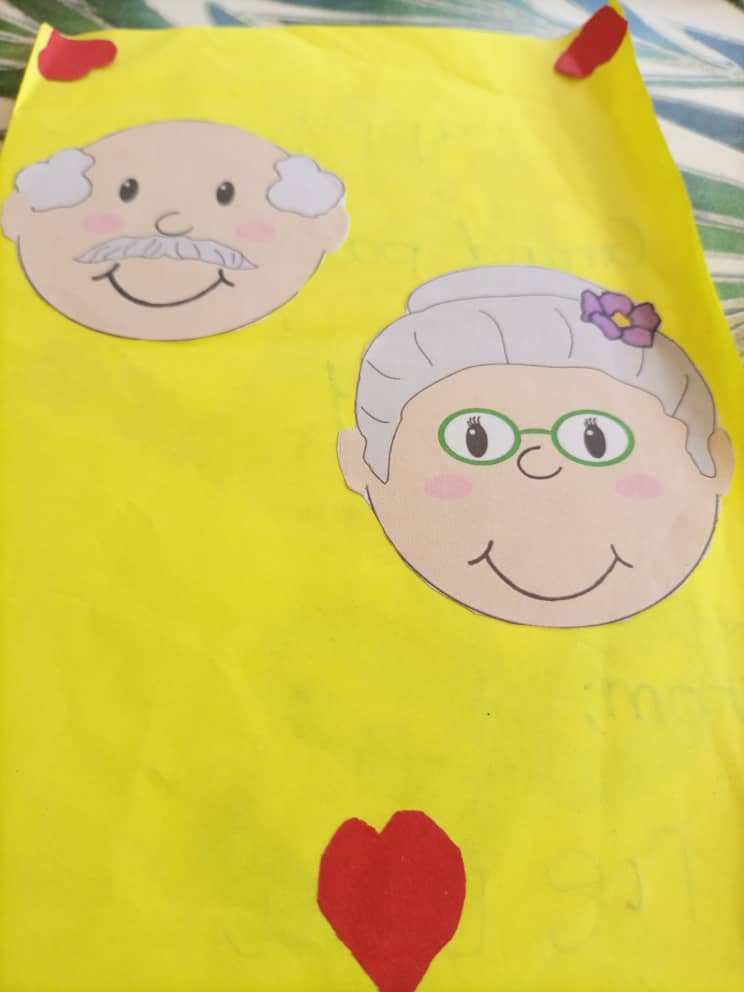
As early as the 2nd September 2023, my four years old grandchild had invited me to join her celebrate the day of grandparents at her preschool, Inyana International School in Kiwafu, Kansanga. With her reassuringly innocent smile she had indicated that I had to be there on that day. The official invitation from the school came later.

On the Friday, 29th September 2023, I dropped everything to be at Inyana school by 10am. I was simply dressed in an olive-green dress, light green jacket and pair of low-heeled beige shoes.

Amazingly, Nanziri’s paternal grandmother had beaten me to it!

We were warmly received by our grandchildren who looked very much alike in their red T-Shirts over black trousers and black shoes. The teachers were also in red and black.

The grandparents were of all ages and sizes; some were dressed in the colourful African prints, traditional busuti but majority were elegant and vibrant in the modern dresses and suits without neck ties. There were two couples from the Far East.

 There were two young couples of my daughter’s age. Later I learned that the grandparents lived far away from Kampala so the parents had chosen to stand in for them. It worked wonders for their children.

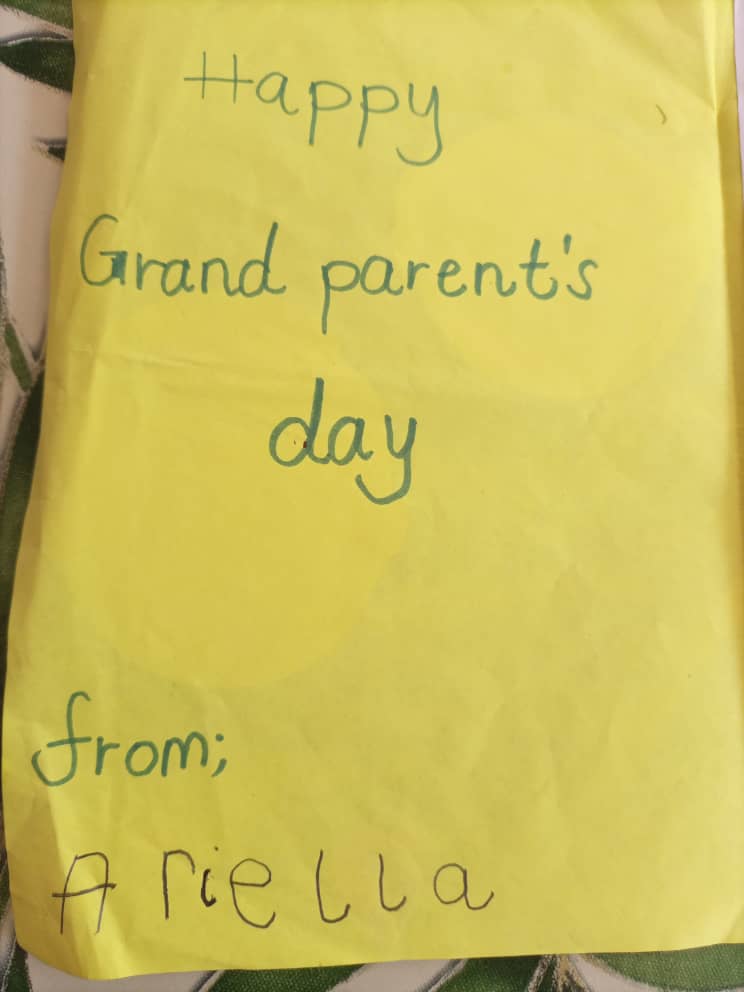
The grandchildren sang songs for us then accompanied us to their different classes to look at their books and creative pictures on the walls. Each guest was given a card put together by the grandchild.

Under the eyes of her teacher, Nanziri was not as spontaneous as she usually is at home.

It drizzled and we sought shelter in those small classes. We squeezed ourselves on

 the tiny chairs and desks! It all seemed so long ago since I last sat on such  a small – sized chair!

Something magical happens when parents turn into grandparents.’’– Paul Linden

The school arranged for each student to take three photographs with each of  her/his grandparents. These were later sent to us on the parents’ phones.

I remembered I had a few photos of my classmates in Junior school and senior school. Some were taken during the school plays that we used to perform at the end of each year. Over the years I have come to treasure them immensely.

By the time we left at 12:30,  a few of the youngest grandchildren were crying for their grandparents and were being calmed down by the class teachers. Nanziri had joined the boys racing big trucks on the floor.

I left the school happy and content for the attention we had been accorded. I was also hopeful for the future as it dawned on me that a part of my history would no doubt form a part of Nanziri’s future.

For over 35 years we had been putting others first: spouses, children but at least for now someone was putting us first. 

Back home, something kept nagging me: in the forty visitors at the school the majority of us were women. Not more than three couples had come in as grandfather and grandmother.

What I had noted was not an exception; globally, females tend to outlive the males.

According to the Uganda Bureau of Statistics Population Projections Reports 2015-2050,

those aged 60 and above make up about 3.7% of the population and the majority of these are female.

The few times I have accompanied my mother to collect her monthly Elderly allowance of 25 thousand UGX (6.67 US dollars), a privilege only for those aged 80 and above. They make up 0.4% of the population :81,600 males and 122,400 females.

By simple observation, the majority of these are females even in our communities. This is how it has been since I was growing up in the 60s.

Countries with highest life expectancy at birth in Africa are:

Algeria 77 years, Tunisia 76, Egypt 70 and Senegal 69 compared to Japan’s 84.

Japan is a country with the world’s lowest birth rate(1.26 in 2022) translating in only 771,000 births,  and the highest number of older people: 29.1 % are aged 65 and above. 1 in 10 people in Japan is aged 80 or older. The working –age population pay more to support the elderly- costs of health and retirement programs.

Even in this oldest population, 51% are females while 48.7% are males.

Scientific studies have tried to explain the gender difference in life expectancy.

At birth, generally there are slightly more male births than female births- about 105 boys for 100 males. For unknown reasons, the “Y”- chromosome bearing sperm is more likely to fertilise the female egg than the “X’’- chromosome bearing sperm.

 The female species has two “ X’’ chromosomes compared to the males one who has “X’’ and “Y’’. The  extra X chromosome in the female acts as a genetic reserve when a genetic mutation occurs on one of the genes.

 The biological protective effect comes into play from puberty (10-14 in girls and 12-16 in boys).  The female species starts producing the female hormones the main one being Oestrogen and will continue until menopause 45-55 years. The male produces the male hormones the main one being testosterone.

 Researchers have shown that Oestrogen protects the women from premature heart disease-it lowers the “bad’’ cholesterol, LDL, in the blood which clogs the arteries and results in arterial stiffening. Clogged arteries cause reduced blood flow to the heart and brain causing heart disease and stroke.

On reaching menopause, the ovaries stop producing the female hormones; the oestrogen deficiency causes the risk of cardiovascular disease to increase in women.  The women gradually catch up with the males.

3. The social factors affecting longevity.

In most communities, men tend to take up the most dangerous jobs like construction, truck driving, logging, mining, fishing and working in the armed forces. Such jobs increase their risk of early deaths. Generally, men take more risks than the females making them more susceptible to life-threatening injuries.

Lifestyle plays a part, as men tend to smoke more than females and to abuse alcohol and drugs. This increases their risk for heart disease and cancer.

Women are the primary care providers – taking care of children , the sick and the elderly. They visit clinics and hospitals more often than men. They tend to build up information and awareness about diseases resulting in better health seeking behaviour than the men.

Men tend to visit health facilities late for chronic diseases or cancer.

Women tend to form strong social groups in their communities. They share stories and information and build each other up unlike males of their age groups.

 Sadly, in Uganda, 228 women die in labour or in pregnancy-related complications per 100,000 live births. However, education and economic empowerment is gradually helping women to control their fertility.

All the elderly in our communities should be treated with respect, dignity and be made to feel that they still matter. Celebrating them often offers them an opportunity to engage actively with the people around them. An inclusive community helps to foster a sense of belonging and acceptance- feeding into the mental and emotional wellbeing of each individual.

“ Nothing is a waste of time if you  use the experience wisely.’’- August Rodin

QUESTION : 

 How often do you take off time to listen actively, connect and share thoughts and experiences with those older than you or younger than you with the aim of fostering understanding between different generations and finding areas of common interest?

THE RAINS ARE HERE

My lush green field in the village after a week of good rains.

As long as I can remember, the agriculture sector  has been the most important one in Uganda.  Currently, it employs 72 percent of our population and contributes about 32 percent of the Gross Domestic Pruduct.

Many of us of my age were educated on earnings from coffee and cotton and we survived the civil wars partly because we could plant food items like plantains, maize, cassava , sweet potatoes, beans, ground nuts, peas and feed on them.

Surprisingly, very little has changed since my childhood as peasants still use the hand hoe and depend on the natural weather conditions. The distribution of food crops from areas of abundancy like the south and west of the country to areas of scarcity like Karamoja in the north still remains a huge problem.

If commercial farming and irrigation is widely introduced, then Uganda could become the food basket of Africa- feeding 200 million people. Available statistics show that 80 percent of Uganda’ s land is arable but only 35 percent is being cultivated. 80 percent of our population live in the rural area; they till the land and sow crops but have limited knowledge of modern farming practice. By cultural practice, the land tends to be divided into small plots for the families. The quality of seeds available to the farmers is poor.

I remember growing up on a hundred acres’ farm about 70 kilometers west of Kampala, Uganda’s capital city. The farm employed about twenty workers, we kept a big herd of cattle and goats. We grew coffee, cotton, plantains fruits like pineapples, passion fruits, oranges throughout the year . My parents could sell over four hundred bags of coffee each season and the Indian buyer collected them from the farm.

The Ministry of agriculture was well funded and the field officers trained in supervising the  farmers of the main crops were a permanent feature in all our villages to ensure high production  and quality from the land.

Uganda’s agricultural potential was hugely affected by the civil wars of the 70s and 80s.

At the moment, the global climate effects are creating hardships to different communities in the world.

These include:

  • Extreme weather conditions- droughts and floods are becoming more frequent and severe. The temperatures have increased and there is more erratic and heavy rainfall. Forced displacement is on the increase leading to hunger and poor nutrition.
  • Increased incidence of pests and diseases- the high temperatures and humidity enable insects and pathogens to reproduce easily. Making it essential to use chemicals and fertilisers.

The climate change effects result in low crop yield and low animal productivity.

Uganda stands a great risk from climate change but being among the least developed countries of the world, we are hardly prepared for it.

The rains of the second season started in early September and suddenly, the fields are all fresh and green. As I travel to my small field near Mityana, I am thrilled to see people clearing and planting seeds in their own. If the rains are not so harsh, the beans will be harvested in eight weeks, maize in three months and pumpkins in four months! The prices will be determined mainly by the usual market forces of supply and demand. Households will have food till the next rainy season.

Once a doctor, always a doctor. The lush green fields reminded me that my colleagues and other health workers in Uganda are now busy looking out and treating more cases of Malaria disease.

Everyone who grows up here in Uganda knows this close association of heavy rains or planting season with high incidence of Malaria fever. The girl children know it so well because they are entrusted with looking after their siblings while the mothers are out in the fields.

I grew up knowing what to give to my siblings and how to give it if he/she developed a fever at home in the absence of an adult.

Hardly anything has changed! According to the Ministry of health , malaria remains the leading cause of morbidity and death in Uganda.  Malaria is endemic in 95 percent of the country and in 90 percent of the population- 33million people. It is responsible for 35 percent of hospital admissions and 9-14  percent deaths. In children under five years, it causes more than 50 percent of the deaths.

 From afro.who.int/Malaria website:

World Health Organisation(WHO) recorded 619,000 deaths due to Malaria in the 84 endemic countries in 2021.

95 percent cases reported were from Africa and 96 percent of the deaths were in Africa.

78.9 percent of deaths were in children under the age of five.

 For Uganda, WHO estimated 13 million cases of Malaria  and 19,600 deaths due to malaria in 2021. Malaria is a preventable disease.

Malaria is a serious mosquito –borne tropical infectious disease caused by five species of  the plasmodium parasites. The female anopheles mosquitoes bites an infected person and transmits it to the next persons it bites.

The parasite requires warm temperature above 20 degrees centigrade to complete its growth cycle in the mosquito. In cold temperatures below 20 degrees centigrade (68 degrees Fahrenheit) the parasites cannot survive to be transmitted by the mosquito.

Climate change result in high average temperatures , allowing mosquitos to survive even at high altitudes.

We are in the El Nino event year with high rainfall and high average temperatures so malaria cases are likely to increase even in areas of high altitude. People living in such areas have low natural immunity to Malaria due to infrequent exposure to the parasites. They are likely to get the moderate to severe forms of the disease.

People like me who grew up in the endemic areas of Malaria have had frequent bites of the mosquitos and developed some degree of natural immunity to the disease. We tend to get mild or moderate forms of the disease.

Having said that , I am now among the most vulnerable group of the population : children under 5 years   pregnant women, people living with HIV/AIDS and mobile populations,

 for acquiring Malaria infection.  For the 25 years I was away in a country with few malaria cases, I lost the natural immunity I had acquired in the 40 years of my adult life. Frequent exposure to malaria through mosquito bites sustains the acquired immunity. If I got infected now I would get the severest form of malaria and could easily die. I sleep under an insect- treated mosquito net all the time to minimise contact with the mosquitos.

My 12 years old daughter survived a severe form of malaria after being away in Botswana for six years. She was only saved by our high index of suspicion of the disease and quick access to the right diagnosis and effective treatment then.

An old childhood friend who had retired and returned home after thirty years in Botswana did not survive the malaria assault four years ago!

In my 46 years of medical practice I have been guided by the cardinal rule I was taught as early as the third year of training:

In Uganda, any fever is Malaria until proved otherwise.

The Malaria blood slide /rapid test can  be repeated in the patient as often as it is required.

Putting these two in practice, saves many lives.

Malaria cases increase during the rainy season because waterlogged and damp places provide suitable breeding grounds for the mosquitos that transmit the disease among the humans.

Malaria is a preventable disease and WHO collaborates with the 84 countries endemic for Malaria to develop and sustain national prevention and control programs whose main goal is to reduce malaria infections and malaria –related deaths. And finally eliminate Malaria disease.

In most least developed countries like mine, such programs tend to be stalled by lack of funds.

On the ground, the biggest challenges are :

The mosquitos continue to develop resistance to the common insecticides used to kill them.

The Plasmodia parasites continue to develop resistance to the effective drugs used for treatment over time.

These two demand rigorous surveillance and regular review of the drug policy.

The frequent shortages of drugs in the government health facilities contribute to the high number of deaths and  to the development of drug resistance.

The main WHO recommendations for the prevention and control of Malaria in the endemic countries like Uganda are:

  1. Prevent transmission by spraying waterlogged, damp areas around the homes. Clear the bush around houses.
  2. Use screens in windows and doors to keep out the mosquitos.
  3.  Indoor residual spraying. Wear long pants and long sleeves to cover exposed skin. Apply mosquito repellents to exposed skin if staying outside for long during the night.
  4. Sleep under an Insecticide –treated mosquito net all through the night every day.
  5. When visiting from a non-endemic area take Malaria preventive tablets two weeks before you enter an endemic area, take it throughout your stay as prescribed and continue with it for two weeks after leaving the endemic area.
  6. Malaria Vaccine- a new tool in the control of Malaria kit. In 2019, a malaria vaccine was launched in Ghana, Malawi and Kenya with the aim of reducing the disease burden and deaths due to Malaria in the under five. Four doses  are given at regular intervals for maximum protection along other routine childhood vaccines. It is an ongoing pilot study to be rolled out nationwide and other countries.

As for the treatment of Malaria infection in all ages, it demands early diagnosis and treatment with the effective drugs of the area and follow up.

Malaria disease will for a long time remain on top of Uganda’s public heath agenda though we have many other intractable diseases that kill millions of us every year.

 Defeating it requires the participation of everyone.

While the farmers are busy tilling their land and sowing, the health workers should be busy reminding the population of their vital role in the prevention and control of Malaria. The trainers should be training the health workers on best practices and changes in the drug policy and the suppliers stocking the health facilities with the effective malaria drugs and the diagnostic kits.

Prevention has always been better than cure and cheaper too.

QUESTION:

Are you aware that a bout of malaria  reduces your productivity at home, in your field or at your work place? Are you taking all the necessary precautions to limit your exposure to the malaria transmitting mosquitos more so during the rainy seasons?

THE NATURAL BORN ANIMAL LOVER

I wrote this post in 2019 about a great animal lover in Kampala, Uganda. Mrs. Adelina Lubogo is still going strong. She is celebrating her 90th birthday today, 24th August 2023.

I am wishing her a happy birthday and many more in future. I am reposting the same article in her honour and great respect.

Uganda has only one centre for the Prevention of Cruelty To Animals – USPCA. It was founded in 1996 to promote animal welfare and support animals who cannot support themselves. It depends entirely on the generosity of the people. It is located in Mbuya , Kampala. It shelters more than 200 dogs, cats and puppies and kittens awaiting adoption. You can learn more about this organisation on their website uganda-spca.org.
In a country where the majority of the population are struggling for their own survival, adopting a pet is an unlikely option. However, there is one animal lover whom I have known since the 1960s. She is a teacher by the names of Adelina Lubogo. To her family and her catalogue of friends she is simply known as Aunt Lena.

For all the time I have known her, she has never had less than five dogs and two cats in her home! Recently I learned that things have remained the same in her home in the twenty two years I have been away in economic exile.
Maya Angelou said: “When we give cheerfully and accept gratefully, everyone is blessed.”
Jesus taught us that it is always more blessing to give than to receive.

I had not seen Aunt Lena since the beginning of the year so last month I made it a point to check on her. She came down to open the metallic gate for me and there- lo and behold! – She was followed by five dogs of different breeds, size and colour and a cat. After a giving me a bear’s hug, she led me into the house. Over fresh hibiscus juice and graviola(soursop) fruit juice ; all fruits from her garden behind the kitchen, we caught up on each other’s lives. Her only son left home for university decades ago and settled in USA so Aunt Lena lives with a helper. At 86 she is still vibrant and energetic and prepares everything herself that she serves to her visitors. She finally sat down to share the juices and sweet plantains chips with me while her family of dogs watched like eagles over us.

“Aunt Lena, I’m surprised that you only have these few,” I said, smiling.
She laughed, “They could be more but now age is catching up with me, I’m learning to restrain myself. I used to find it terribly hard to say no but slowly and surely, I’m getting there.”
“There must be a Snowy among these,”I said, reaching out for more chips.
“Yes, indeed. That white one with long hairs,” she said, pointing to it. Believe or not, each dog except Snowy has a long story behind her or him.”
We exchanged knowing smiles.
I poured myself more of the rare delicious, fresh graviola fruit juice and listened intently.

I’m starting with that Maltese poodle seated near the door to dare anyone coming in here.
A relative of mine brought it here almost three years ago. It was a small, unruly dog but it’s now one of the most well-behaved dogs that I ‘ve ever cared for. When the young man brought it here he had smiled and told me that he had something small for me. I had no idea about what he was talking about until he opened the spacious car boot. I peeped and saw a frightened small dog on a leash.

He had gone on to tell me that for two days he had passed by one trading centre and seen men throwing stones at the small dog. On the second day, he had stopped and asked those men why they were being unkind to the dog. They had told him that it was bothering them as it looked for food. They did not know its owner. He had driven to the nearest supermarket and bought a leash so that he could rescue the dog. He had driven straight here knowing very well that I would give the poodle a loving home. Since then it has become my best keeper and friend.

There is a black sausage dog(dachshund) that was given to me by my nephew’s eleven year-old daughter. Her dog had two puppies. She chose to keep one and bring the other one to me with a lot of love.That small black one is a recent acquisition. Three months ago I was in a queue at a supermarket talking to a friend. She was consoling me after I had lost one of my old faithfuls.

Three days later when I went back to pick some grocery items, the manager had appeared from behind and greeted me with a big smile.
“I understand you lost one of your dogs. If you don’t mind, I have a puppy for you.’’ He had disappeared behind the tills and came back with a puppy in a box. I was caught off guard but was happy to get a replacement.

This reminded me of what my other nephew, now a seasoned lawyer, had done in the early 1970s. Their neighbour had moved away but left his old cat behind. The cat made it a habit to go to their house to look for food. The mother would leave food and water for it on the veranda. The nephew had pleaded with his mother to adopt the cat. It proved difficult since the nephew suffered from bad Asthma.
“If we can’t keep it, then I know the right place for it. Let us take it to Aunt Lena,” the nephew had made the recommendation with a sense of warmth and pleasure.

Amazingly, that is how it has been to this day; my home has been a shelter for stray cats, rescued dogs and extra puppies. One time a Snowy had suckled two kittens picked from the neighbourhood. I took some good photos of this natural nurturing instinct unfortunately my camera was stolen at a party.This was long before the invention of the digital phone camera. I have many more stories to tell of my friends, it may take the whole day!”She concluded with a hearty laugh.

“What do you get out of this hands on care?” I asked.
“Ever since I can remember, caring for animals and gardening have given me a normal life outside work. I treat my pets as friends and they return love and loyalty to me.”

I felt privileged to know this amazing woman. She is loving, selfless and has a big heart. She has many caring friends, she spends one day in the week at the Centre for the Disabled teaching the children Art and bead work and she is a natural animal lover. No wonder she is still energetic and vibrant at her age.

Later at home, I read about the psychology behind loving animals and being concerned about people. It helped me understand Aunt Lena better. She must have been given so much love and care in her childhood that she learned to be kind to herself and then go out to love other people and animals.

Caring for people and animals is the highest expression of her compassion. With a deep well of love in her heart, she can give without maiming herself. She must have felt secure with her parents to develop her own identity and establish her own boundaries. She loves and accepts others without breaking her boundaries and losing her identity.

Talking to her, she indicated that she was more than willing to give and love until she breathed her last. She is an incredible woman!
Thank you, Aunt Lena, for teaching us to love and care for ourselves, other people and animals and to assert ourselves. We are the richer for knowing you.
The famous Anne Frank said: “No one has ever become poor by giving.’’
And Ralph Waldo Emerson said: “The purpose of life is not to be happy. It is to be useful, to be honourable, to be compassionate, to have it make some difference that you have lived and lived well.”

Writing this post has got me thinking that if each one of us worked brilliantly at her/his small part that fits into the big picture, we would make the world a better place.

I am curious:
What are you doing in your community to make other people’s lives better or make them feel that they matter?
Are you an animal lover? Has this post stirred you into adopting a dog or cat or supporting the Uganda Society for The Protection and Care of Animals?

SHARE THIS:

Press ThisTwitterFacebook

HONOURING A FRIENDSHIP OF OVER 50 YEARS

The two years COVID-19 lockdown was unprecedented in the history of mankind.

It changed us and everything in our lives; from the way we care for others,  communicate, work at home and at the work place, the way worship at religious places, the way we educate our children, the way we buy things and much more. It forced us to learn how to focus on one day at a time.

At the same time, it left big scars on many of us.  We lost many loved ones to this new disease. We were unable to mourn for them and bury them as we traditionally do to get closure.

Among the loved ones I lost was my great friend : Dr. Sarah Namuli Mukasa Yiga, a mother of four and many others who needed mothering wherever she lived and worked.

We had known each other since our secondary school days in the 60s!

She had lived and worked in Apartheid South Africa and then later in the Rainbow Nation born in April 1994.

In the last twenty five years, we were neighbours as she worked in Bloemfontein (Free State province) South Africa while I worked in Botswana. Namuli and I were kindred spirits.

She died in an Intensive Care Unit in Bloemfontein on 12th January 2021, a funeral service was held three weeks later.

Due to the lockdown, I could not be there in person but virtual attendance was arranged for me by my niece, Gladys, through a VPN. General elections were held on the 14th January 2021 and internet access was strictly limited in Uganda.

To numb my pain and heartache, I wrote a befitting tribute to Sarah and posted it on my blog : The lady with an Infectious Smile.

← Back

Thank you for your response. ✨

Time moved on. It is now two years and five months and the family feels comfortable enough to return Sarah’s ashes for burial on the 11 th of August 2023 at their ancestral burial grounds near Masaka city, 133 km  west of the capital city , Kampala.

This will give us the long awaited closure.

I shall not write another tribute but instead I have compiled some quotes and proverbs about genuine lasting friendship in honour of Sarah ‘s memory.

Truly close friendship does not just happen; the two people involved have to make an emotional and time investment in it.

My late father had several treasured friends for whom he would drop anything to help and they would do the same. Some of them knew him more than he knew himself and could second guess him.

We considered them as relatives until much later in life! Thankfully, this is one trait all of us, his children have inherited from him.

Similarly, Sarah ‘s children always took me as a relative.

For her family had become mine and my own had become hers. I am richly blessed to have a number of such true friends. They bring so much happiness, stability and understanding into my life. Their hearts serve as a deep well of love which I can always draw from as long as I replenish it.

It takes years to create such true friendship. As you get to know each other more, each one opens up to share dreams, hopes and fears and then support each other through it all. As you get to understand each other you build trust and loyalty for one another.

They are all weather friends – sticking around during tough times. They challenge and inspire you to become the best of you

“It’s the friends you call at 4a.m that matter.”- Marlene Dietrich

A friend is someone who understands your past, believes in your future and accepts you just the way you are.” – Unknown

Psychologists advise us on what to look out for as you identify your real friends.

  • Good friends accept you for who you are- strengths and flaws
  • Stick around during the good and bad times.
  • A real friend celebrates life with you- small and big achievements
  • A true friend makes time to see you
  • A true friend encourages you to achieve your goals
  • A true friend empowers you to be you, does not maim you.

The highest form of friendship is built on mutual recognition of one another’s virtues.

The psychologists also have outlined the forces that form and sustain a friendship.

They include:

Accumulation- over time you open up to each other, listen to each other getting deeply connected as you share moments, celebrate and mourn losses.

Pay attention- to the people around you to find good friends among them.

Be Intentional- put yourself out there and find good friends, make yourself humble and vulnerable. Look for friends of all ages.

Rituals- find routines to cement the friendship, like organising book clubs, dinner or tea parties,

In this digital era, group chats warm up friendships.

You can attend weddings, funerals, children parties together and celebrate important milestones together. This keeps cherished moments etched in our brains.

Imagination-  stretch your imagination to keep your friendship alive despite the demands of family, marriage and career. Sarah and I arranged to go for a two-week pilgrimage to Israel in 2011. It turned out to be an unforgettable experience. We were talking of a ship cruise together in the future.

Reconnect- Whether it has taken decades or weeks without meeting in person, have the grace to reconnect and catch up on each other’s life. Reunions with old friends always fills up the gaps.

Video calls, Zoom meetings are doing an incredible job in keeping friends close and connected.  I for one feel that nothing beats a physical presence – offering verbal and body language communication.

Some African proverbs about true friendship:

Show me your best friend and I will show you

 your character.

Akatono Okalya nemunno: The little food you have is most delicious if shared with a friend.

Honest friendship does not destroy true friendship.

In good times friends know you, in bad times you know them.

The friends of our friends are our friends.

There is no better mirror than a best friend.

Hold a true friend with both hands.

Return to old watering holes for more than water; friends and dreams are there to meet you.

If you choose to make friendship with a pig, you must be prepared roll in the mud.

To be without a friend is to be poor, indeed.

Bad friends will prevent you from having good friends.

Teeth are all friends among each other.

Between true friends, even water drunk together is sweet enough.

Some quotes about True Friendship.

“Your friend is your needs answered. He is your field which you sow with love and reap with thanksgiving. And is your board and your fireside.”- Kahlil Gibran

Friendship is not a big thing – it’s a million little things.”- Paulo Coelho

As I string my pearl necklace of friends, a smooth, round white pearl is a rare find. Whoever finds it, is made happy for life.’’- Jane Nannono    

A friend knows the song in my heart and sings it to me when my memory fails.”- Downer Roberts.

Friendship is the only cement that will ever hold the world together.” – Unknown

In the sweetness of friendship let there be laughter, and sharing of pleasure. For in the dew of little things, does the heart find its morning and is refreshed.”- Kahlil Gibran

A sweet friendship refreshes the soul. – Proverb 27: 9

True friends are always together in in spirit.”- L.M Montgomery

The best gift anyone can give, I believe, is the gift of sharing themselves.”- Oprah Winfrey

Try and be a rainbow in someone’s cloud.” Maya Angelou

Let there be no purpose in friendship save the deepening of the spirit.’’- Kahlil Gibran

Friendship is always sweet responsibility , never an opportunity.’’ – Kahlil Gibran

I belong to the people I love and they belong to me- they, and the love and loyalty I give them , form my identity far more than any word or group ever could.’’– Veronica Roth

In the end, we will remember not the words of our enemies, but the silence of our friends.’’- Martin Luther King, Jr

 Sarah Namuli you are greatly missed every single day but we are comforted in knowing that you are one guardian angel whom we know by name.

RIP

QUESTION:

Are there occasions in your life when a friend who is far away seems nearer than the one at hand?

THE SMALL VILLAGE OF GIANTS

 My grandfather settled in a small village called Lungujja a few kilometres from the Kabaka’s palace in Mengo. It was not far from Old Kampala hill, where Captain Fredrick Lugard of the Imperial British East India Company , the architect of the Uganda Protectorate, built his base in 1891.My father walked barefoot from this place to Mengo Primary school, the first church missionary school in Uganda.By the time I was born in the early 50s, the small village had grown and was home to Michael Kawalya  N.Kaggwa , a former Katikkiro/prime minister ( 1945-1950) of the Buganda kingdom.

In the 60s, this parish was home to Abubaker K.  Mayanja, among the first Ugandans to be educated at Cambridge University. A lawyer, freedom fighter and a political giant till his death in 2005. His neighbours included Ephraim Kamanyi , a Minister of Education for the Buganda Kingdom and lady Kate Sarah, mother of the two daughters of Sir Edward Mutesa, the 35th Kabaka of Buganda and first President of Uganda.Roger Mukasa, chairman of the prestigious Uganda Coffee Marketing Board, Timothy Lwanga, the tough and professional head of the then Buganda Police, Magistrate Kyobe whose family suffered the loss of two male relatives in February 1981 when the bush war against Milton Obote was launched . Only to find out later that it was a case of “mistaken’’ identity. Not surprising at all because Prof Yusuf Lule’s home was a stone’s throw from his home.  At the end of May 1966, Dan Kamanyi risked his life after the Uganda army’s attack on the Kabaka’s palace, to drive Sir Edward Mutesa to safety as far as the Burundi border.Hope Mukasa, a renowned singer of the 70s and 80s was born and raised in this village as well as the talented national footballer, Ashe Mukasa.

My father was an administrator who became the Katikkiro of Buganda ( 1950-1955) later went on to become the second  indigenous Mayor of Kampala city and a chairman of many voluntary organisations like Uganda Red Cross Society, Young Men’s Christian Association, YWCA, Uganda Boys Scouts, The Bible Society of Uganda, Lions Club, and Uganda Civil Society.Everyone knew each other and every child belonged to the whole village. For many years, my father had the only telephone in the village and allowed the members of the community to use it for emergencies for free. Emergencies ranged from calling back a father from the office to return home and take a sick child to the hospital to calling the fire brigade to kill a python. I do not remember any house break in during my whole childhood!

“Every person is defined by the communities she belongs to.’’ – Orson Scott Card

 During the 70s , Kintu Musoke , a politician and a journalist joined the village. He went on to become the Prime Minister of Uganda from 1994 to 1999.        Other new comers included  Rev. Canon Sentongo, by then the Secretary of Makerere University . His wife, a nutritionist, taught at Lubiri Secondary school and baked the most delicious fruity wedding cakes in Kampala! Fred A. Mpanga , a former Attorney general of the Buganda Kingdom and married to Joyce Mpanga who later became the first Minister of the Ministry of Women in Development and later State minister for primary education( 1989-1992) settled in.

 The only outsider was someone from Busoga,  near our home. He worked with one of the corporations in Kampala.Yusuf Kironde Lule, a professor and civil servant , the first indigenous Principal of Makerere College, joined the village. He became a freedom fighter during the authoritarian rule of Obote. In April 1979 , he was sworn in as 4th President of Uganda.Prof. Eric Paul Kibuka a social scientist came in and later became the head of the Department of Sociology and Anthropology of Makerere Univesity. As an immediate neighbour to us, he became a close confidant of my father.Lawyer Edward Sekandi who later went on to become the Speaker of Parliament (2001-2011) and the Vice President of Uganda May 2011 to June 2021.Business man Jim Kiggundu of the Kibanda boys, Prof Paul Sagala of the faculty of Engineering, Makerere University and Senior Police officer Mukiibi joined our community.

 During the 90s, Prof Peter H. Sebuwufu, an exceptional professor of anatomy of Makerere University, settled in the village. He later became a politician and served as a Minister of health. Currently, he is considered among the giants of Medicine in Uganda. Professor Fred Kigozi, a global and national giant in Psychiatry, for a long time the Director of Uganda’s only Psychiatric teaching and Referral hospital, Butabika,( 1992-2008). He was instrumental in revamping the mental health services of Uganda. Sadly, he and his wife died a few weeks between each other just before the Covid-19 pandemic lockdown.All these people and their wives used to visit our home on many occasions and their children became our friends.A few other notables settled in the village in the 2000s.

 Lungujja has grown, expanded and developed a unique personality- active but peaceful. No slums yet.It constantly reminds me that places are made by people- their culture, attitudes and values and social organisation. All the years I was way, I would go home and make a village round. The welcome and love shown to me long after my father’s death, would recharge my emotional battery until my next visit!

“When you have a solid upbringing and a strong sense of place, that sustains you. My sense of home never leaves me.’’- Lyle Lovett

All these families had benefitted from the good education of their parents so they have continued to educate the grand children of the village.In my family we have had a journalist, a Police officer, lawyers, a nurse, a social worker, a medical doctor, a pilot, a caterer and an IT officer. Our own children have pushed it to a higher level. They include engineers, lawyers, a journalist, a financial expert, Real Estate managers, an Insurance consultant, a diplomat and a medical doctor. Conspicuously missing is an active politician!

 “Education is the most powerful weapon which you can use to change the world. ’’- Nelson Mandela 

The period 1981- 1986 was previously Uganda’s worst time of uncertainty, powerlessness- politically, socially and economically.Lungujja being a village of conservative Baganda, close to the Lubiri, naturally became an ideal hotbed for organised resistance to the authoritarian government of Obote 2. It became a more tight-knit community during the insurgency. Residents looked out for one anotherProf Yusuf Lule and his group of freedom fighters joined the Popular Resistance Army of Yoweri Kaguta Museveni to form the National Resistance Army(NRA) that liberated Uganda on 26th January1986. After a six -year and costly bush war in the Luwero Triangle.My father by then in his early 80s joined the struggle and persuaded many other Baganda families to support it by encouraging their sons to join the NRA. Due to the tension in the village, my pre- wedding  party could not be held at our home in February 1981. Always leading by example, my father persuaded one of my brothers, Henry Arthur to join the war. Sadly, he was killed in May 1985 , aged 32 and his body was never found. Though survived by some children, my parents carried their pain to the grave! The consolation for such determined Baganda families came in the form of: the coronation of Ronald Muwenda Mutebi as 36th Kabaka of Buganda on 31 July 1993! 

Due to Uganda ‘s long history of civil strife, most of my siblings have been away for decades and our house had fallen into ruins yet it has been a landmark of the village. Taxis  and buses driving through the village related to where you  had to disembark before or after our home.We have been renovating the house since last February.It has been heart-warming to see all those we have known since childhood come out to congratulate us on taking on the huge task. Flooded with great joy as if it were their home. That is how closely connected the people of this community have been. They love their village and its people.Many stop by just to talk , thank us and encourage us to finish the work. Among them were the Kabalis, the Kamanyis, Honourable  Sekandi and  the Rev. Canon Buwembo of Nateete Martyrs church where our father was buried.

There is no pomp or ceremony, we just talk as friends and members of a community with a strong sense of place, connected to a village which we consider important to us. 

“Every successful individual knows that his or her achievements depend on the community of persons working together. ‘’ – Paul Ryan

My father loved his village and used his power in all the positions he held to develop it.He loved the people of the village and they admired and respected him as one of their own. Our home was always open to anyone who cared to pass by. Learning from our father, we developed a strong bond to the people and place. Gradually, it became part of our self-identity. We have many memories and associations to the home which give us a sense of belonging.

No doubt we shall always be drawn to it. Our peers and those who knew our father make us remember so many things about ourselves and our parents and the many relatives who lived nearby. Such memories are associated with many “firsts’’; first day at school, first date, first trip by bus and first party as a teenager.It is this lifelong attachment that drove us into building a new relationship as we transformed the home from an old home into a modern one.

We are committed and are responsible for managing the place in our time and later hand it over to the young generation as our father would have wanted.It is not lost on me that it is the young ones who will sustain the home in the future yet they are  scattered all over the world.  I keep wondering to myself, “Will they care enough to take on this responsibility?’’

Lungujja is no longer a small village but a suburb of Kampala city, the capital of Uganda. There are more stone brick houses with tiled –roofs, few apartments, a big hotel built by Eritreans but few green areas. The roads are narrow and there are a few shops. The perimeter walls are becoming taller and the traffic through the village connecting to the Northern By-Pass has greatly increased. It still has good views of the next hills, Namirembe, Lubaga and Lusaze and remains a middle-income residential area. Over time, it is becoming steeped in its heritage and history.Most of the traditional family homes of the the Kamanyis, the Kabalis, the Etuusas, the Sentongos and Wakatamas are still occupied and cared for in a united community.

Looking around the area, there is hardly any space for young families to put down roots, so the older ones have to care enough to preserve, rebuild and improve those homes.Lungujja had a big place in the minds and emotions of our parents so it is the responsibility of us the children to reconnect with our village.Amazingly, at whatever time I pass through this village, it always feels old and familiar and safe and dry. I feel as if the memories and associations are always waiting for me to come back.I guess I am not the only one whose identity is rooted in the home I was born and raised. 

“A tree’s beauty lies in its branches but its strength lies in its roots. ” – Marshona Dhliwayo 

“Live in your roots, not in your branches. ” – Nancy Willard. 

QUESTION:

How has the place you were born and raised in influenced the person you have become?    

SOME QUOTES AND PROVERBS ABOUT SOME IMPORTANT ELEMENTS OF LIFE

  1. ABOUT PARENTHOOD – Welcome to parenthood. It might seem overwhelming at first, but sleep comes eventually.

Early parenthood.

General sayings:

“Parenthood is the most beautiful love that stays ever within your heart.’’

“Normal goes out of the window the moment you have kids.’’

“You don’t need the gym, you need a toddler. They never stop moving.”

“Giving it your best is good enough. No parent is ever perfect.’’

“ Enjoy each moment as a parent- the good, the bad and the ugly. Before you can blink, they will be all grown up. ‘’

“Your child is not looking for the perfect parents. They just want you. Give them you time and love. You will be absolutely perfect in their eyes.’’

“Parenting looks easy until you realise that you are responsible for a life. Then it gets really complicated.’’ 

“Train up a child a child  in the way he should go and when he is old he will not depart from it.”  Proverb 22:6

“Unhappy parents will not raise happy children,’’

  “ Every moment is a moment to build a bright future together with your child.’’

              “ Live so that when your children think of fairness and integrity, they think of you.’’– H. Jackson Brown . Jr

“ Kids spell love T- I – M –E.” John Crudele

“Each day of our lives, we make deposits in the memory banks of our children.’’- Charles R, Swindoll

“We cannot always build the future for our youth, but we can build our youth for the future.’’- Franklin D, Roosevelt

Parenting adult children.

“Happiness is when you realise that your children have turned out to be good people.

“For children to capture their dreams, they have to be allowed to soar free.’’

“Having children isn’t the hard part; letting them go is.’’

“To let go gracefully is an art form many parents must perfect.’’

“It takes 18 years to raise an adult. It takes nearly that many to learn to let go of them.’’

“To learn to fly in the adult world, they must learn to fall.’’

“There are two lasting bequests we can give our children. One is roots  and the other is wings.”- Hodding Carter  Jr

  1. ABOUT SERVICE TO OTHERS   

“The two most important days of your life are the day you were born and the day you find out why.’’– Albert Einstein               

“Everyone can be great because anyone can serve.’’ – Martin Luther King Jr.

“I t is every man’s obligation to put back into the world at least the equivalent of what he takes out of it.’’ – Albert Einstein

All of you must put on the apron of humility to serve one another………1 Peter 5:5

 “I slept and I dreamed that life is all joy, I woke and I saw that life is all service. I served and I saw that service is joy.’’– Khalil Gibran

“If you go out and make some things happen, you will fill the world with hope.’’– Barack Obama

There can be no greater gift than that of giving one’s time and energy to helping others without expecting anything in return.’’- Nelson Mandela

3. ABOUT GIVING

To whom much is given , much will be required. Luke 12:48

No act of kindness, no matter how small, is ever wasted.’’- Aesop

He who wishes to secure the good of others has already secured his own. ‘’- Confucius

“The most precious thing I have to give is my time.’’– Silva Hartmann

“It ‘s not how much you give , but how much love we put in the giving.’’– Mother Teresa

“Make a difference in life. Touch people’s lives truly. Use your gifts, talents to benefit society.’’

“ The meaning of life is to find your gift. The purpose of life is to give it away.’’ Pablo Picasso

Always give without remembering and always receive without forgetting.’’- Brian Tracy

4. ABOUT LEARNING – learning is a lifetime job.

“ Anyone who stops learning is old , whether at twenty or eighty. Anyone who keeps learning stays young. The greatest thing in life is to keep your mind young.’’– Henry Ford

“ I am still learning.’’– Michelangelo ( at 87)

A man who asks is a fool for five minutes. A man who never asks is a fool for life.’’- Chinese Proverb

The greatest teacher , failure is.’’ – Yoda

“In the end we retain from our studies , only that which we practically apply.’’- Johann Wolfgang Von Goethe.

“The greatest aim of education is not knowledge but action.’’ –  Hubert Spencer

“Change is the end result of all true learning.’’–  Leo Buscaglia 

“ Wisdom is not a product of schooling but a lifelong attempt to acquire it.’’- Albert Einstein

“I hear and I forget, I see and I remember. I do and I understand.’’- Confucius

By three methods we may learn wisdom: First, by reflection, which is the noblest; Second , by imitation, which is the easiest and third by experience, which is the bitterest.’’  – Confucius

Acquire new knowledge while thinking over the old, and you may become a teacher of others.” – Confucius

 “There is no end to education. It is not that you need a book, pass an examination and finish with education.The whole of life from the moment you are born to the moment you die, is a process of learning. ‘’– Jiddu Krishnamurti

“Live as if you were  to die tomorrow. Learn as if you were to live forever.’’ – Mahatma Ghandhi

“All the world is my school and all humanity is my teacher.’’- George Whitman

God teaches us letter by letter, line by line, lesson by lesson.  Isaiah 28:10

5.THE DIGITAL AGE – Digital transfer is essential to all of us to survive in this era.

“I fear the day that technology will surpass our human interaction. The world will have a generation of idiots.’’ – Albert Einstein (1879-1955)

“There are no boundaries or borders in the Digital Age.”- Karim Rashid

“ We live in a digital world , but we’re fairly analog creatures.”-  Omar Ahmed

“Creativity is about connecting things.”- Steve Jobs

“Let’s go invent tomorrow rather than worry about what happened yesterday.” Steve jobs

Automation applied to an inefficient operation will magnify the inefficiency.’’ – Bill Gates

It’s no longer the big beating the small, but the fast beating the slow.’’- Eric Pearson

There’s a lot of things lost in the Digital Age.”- Ira Sachs

The illiterate of the twenty-first century will not be those who cannot read and write, but those who cannot learn, unlearn and relearn” – Alvin Toffler ( 1928-2016)

In today’s era of volatility, there is no other way but to re- invent the only sustainable advantage you can have over others-  agility, that’s it. Because nothing else is sustainable, everything else you create , somebody else will replicate.’’ – Jeff Bezos. Amazon founder

“The thing that we are trying to do at Facebook is just help people connect and communicate more efficiently.’’ – Mark Zuckeberg . Facebook founder

People will always want more immersive ways to express themselves. So if you go back ten years ago on the internet, most of what people shared and consumed was text. Now a lot of it is photos. I think  going forward, a lot is going to be videos, getting richer and richer. “ – Mark Zuckerberg

About Artificial Intelligence – AI

AI is learning and reasoning by machines without the intervention of humans. It is developing incredibly fast. It has great possibilities and possible dangers if abused.  It demands for regulation if it is to be used responsibly as a powerful technology tool in any field. Only time will tell the future reality about AI.

By far the greatest danger of Artificial Intelligence is that people conclude  too early that they understand it. “- Eliezer Yudkowsky

“ I ‘m not a robot; I have a personality and I have emotions. I have a humorous side to me and an angry side to me.’’ – Jeff Gordon

In an increasingly artificial world, people will crave for something real. And they will pay more for it.” – Michal Hyatt

6. ABOUT OLD AGE 

Ageing is just another word for living.’’– Cinday Joseph

“Growing old is mandatory but growing up is optional.’’- Walt Disney  

When we were small children, we all played dress –up and everybody had a good time, So why stop ?’’ – Iris Aptel

Count your age by friends, not years, count your life by smiles, not tears.’’- John Lennon

“ Wrinkles will only go where the  smiles have been.’’ – Jimmy Buffet

Suddenly and shockingly, I have found myself to be that ancient person whom the youth forget that she has ever been young. Just as I used to think fifty years ago.’’ – Jane Nannono 

The glory of young men is their strength: And the beauty old men is their grey head. Proverb 20:29

SOME AFRICAN PROVERBS

A child is what you put into him.

 When the roots are deep, there is no reason to fear the wind

A youth that does not cultivate friendship with the elderly is like a tree without roots. 

A child can be taller than his father but can never be older the father.

Even your own child can beat the drum while you do the dancing.

When the ants unite their mouths, they can carry an elephant

The teeth can only bite when they work together

It is not necessary to blow out other people’s lanterns to let yours shine.

The gift basket to the bride –to -be is never returned empty to the owner.

The hands that make mistakes belong to those who work.

The first to start does not necessarily arrive first.

Even if you dance in water, your enemies will still accuse you of causing dust.

You do not ask for a chair when you visit a place where the chief himself sits on the floor.

A bad boy is a pain in the neck but a bad old man is a pain in the heart.

The old woman looks after the child to grow its teeth and the young one in turn looks after the old woman when she loses her teeth.

When an old man dies, a library burns to the ground with him.

Hands wash each other– helping your neighbour is helping yourself in the long run.

QUESTION:

Do you have your own collection of inspirational quotes and Proverbs on your desk? Have they served the purpose you compiled them for?

The Emergency period is over but the infection is still with us.

Corona Virus under a microscope

On the 30th January 2020, the World Health Organisation ‘s Director General , Dr. Tedros . A. Ghebreyesus, declared the COVID -19/SARS- CoV-2 epidemic as a global public health emergency. Little did we know by then, that the crisis will last until May2023! This tiny virus, COVID -19, took over our lives and changed everything as we knew it forever. It started in Wuhan, China, and spread to all countries in the world. Then, on 4th May 2023, the same Director General of WHO declared that the Severe Acute Respiratory Syndrome which killed almost 7 million people and infected almost 766 million people over three years was no longer considered a global health emergency or crisis. BUT the infection is still with us and remains a threat. It requires strict surveillance by all countries to prevent another pandemic.

According to the UN News website: https://news.un.org , the organisation considered several major factors including the Covid-19 death rates that peaked to 100,000 people per week in January 2021 to just over 3,500 per week in April 2023.

• The number of deaths had decreased world wide.

• A great decline in COVID-19 related hospitalisation and Intensive Care Unit admissions- relieving the pressure on health systems.

•High levels of population immunity to the COVID-19 virus through vaccination and infections with the virus – for over 12 months the new cases and the deaths have decreased.

•Availability of better treatment for the secondary bacterial infections and complications.

WHO warns us that though the pandemic seems to be controlled, the virus is still with us, it remains unpredictable. We have to prepare to live with it like any other infectious disease for the foreseeable future.

I wrote several posts about COVID-19 disease on this blog so it felt natural for me to update the available information.

Our reality is an infinite battle between what happened and what we want to remember.’’- Haruki Murakami.

One cannot help but compare the pandemic of the 21st century with the Spanish Flu pandemic of the early 20th century that lasted from 1918- 1919, during the World War 1.The Spanish flu started in Kansas, USA, and spread to Europe but the information about it was suppressed due to the prevailing world war.

According to the https: //www.cdc.gov the Spanish flu was the deadliest pandemic ever recorded at that moment in time.It was caused by an influenza virus H1N1 with genes of birds origin. Its genetic make-up was not sequenced until the 1990s in USA. It never went away. It mutated over time and its descendants continue to cause seasonal flu.

•It infected about 500 million people- one- third of the population of the time

•.It is estimated that it killed 50million people- 2.7% of world population. USA suffered the highest number of deaths: 675,000 people.

• The highest number of deaths were among healthy people of 20-40 years.

•Most deaths were due to the secondary bacterial infection- no antibiotics then nor vaccines to prevent the infection.

FAST FORWARD- A century after the Spanish flu.

•SARS CoV-2 emerged as cases of unexplained pneumonia in Wuhun , Hubei Province of China in December 2019.

•A zoonotic disease transmitted from animals like bats to humans.

•From the Johns Hopkins Corona Virus resource centre website, the last recorded figures show that by the 10th March 2023, the disease had infected a total of 676,609,955 people.

•It had caused 6,881, 955 deaths •A total of 13, 338 , 833, 198 vaccines had been administered worldwide.

•The deaths were highest among the 65+ years of age. They died of secondary bacterial infection which caused respiratory distress, pulmonary oedema and death.

Both the Spanish flu and COVID-19 infections were new diseases when they first struck and the populations had no immunity against them.Similar public health safety measures were used to stop the spread of the infections. The Spanish flu pandemic was controlled mainly by SOCIAL DISTANCING-suspects were isolated or quarantined, public gatherings were stopped.

Facial masks were worn to cover mouths and noses, to help stop the spread of germs.People stayed at home when they developed flu-like symptoms.By then,there were no ventilators, no vaccines and no antibiotics. There was neither WHO or centre for disease control to coordinate the efforts for fighting the pandemic.

The COVID -19 disease would have killed more people but new advances in Medicine and science enabled the virus identity/genome and its mutations to be identified quickly.The Covid-19 virus is closely linked to the SARS-CoV-1 that caused outbreaks of Severe Acute Respiratory Disease in some countries in 2002-2004 .

For decades, scientists have been studying mRNA technology to develop vaccines. The COVID -19 pandemic caused severe health, social and economic disruptions worldwide, giving the scientist an opportunity to develop mRNA- based vaccines other than use the traditional methods. In hind sight, due the urgency and critical need of the vaccines, vaccines were processed quickly through the standard five stages of developing a vaccine clinical stages especially the 3rd one of Safety and efficacy in laboratory and animal models before it is tested in humans. The tests in humans were also hurried through. This is likely to have some consequences in a few members receiving the vaccines worldwide.

Between March 2020 and November 2020, four vaccines against COVID -19 had been developed. The mRNA technology had cut the 5 to 10 years for developing a traditional vaccine to eight months!The world’s first dose of the Pfizer/BioNTech COVID-19 vaccine was given to 90 years-old Margaret Keenan of United Kingdom on 8th December 2020. She received her second dose on the 29th December 2020. She received her spring booster dose 18months after her first dose.I received my 1st dose of the Oxford University / Astra-Zeneca vaccine on the 11th March 2021 and the 2nd one by the end of May, through the assistance of COVA, WHO and UNICEF to my country, Uganda.A variety of broad spectrum antibiotics are available to treat the secondary bacterial infections as well as other modes of treatment like steroids to control the complications.The Internet allowed sharing of information and experiences though in some cases it resulted in misinformation and disinformation of the public.

New technology speeded up diagnosis and treatment and how to control the outbreaks or waves quickly.Data collection and sharing was made easy by digital technology. World Health Organisation, founded in 1948 as the health agency of the United Nations, coordinated the global action to control the spread of the infection.Using lessons and practices learned from the Spanish flu pandemic, WHO set up committees and guided its 192 member countries through the pandemic; about safety measures , treatment , management, dissemination of the right information about the disease and vaccines and surveillance .

As we are living in the age of pandemics , the knowledge and skills we acquire and the partnership we create as we try to control the COVID – 19 pandemic will help us to prepare for and manage future pandemics caused by new germs, better.

As Dr. Tedros Adhanom Ghebreyesus rightly said :

We are not safe until everyone is safe.’’

We are all out and about but we cannot forget how this tiny virus disrupted practically every aspect of our lives and taught us what is most important in life: life itself , being healthy and being connected to our loved ones and friends. As we rebuild the confidence to venture into familiar activities we cannot forget those we lost to the disease, the frontline health workers in our communities and a few of us who are still fighting to defeat what has been called ‘long COVID’.

QUESTION :

How have you adapted to the new normal after the monotony of daily life during the three years of COVID-19 pandemic lockdown?