MY UNSUNG HEROINE

The month of March is seared in my memory as the Women’s month worldwide. It triggers specific memories about the struggles that Ugandan women have gone through and continue to endure to be recognised and rewarded as full members of a patriarchal society. Surely , we have come a long way since 1984- the time we celebrated the International Women ‘s day for the first time in Uganda.

This year’s celebrations were held at Butemba College in Kyankwazi District, South Buganda. My nonagenarian mother sat glued to the television to watch the celebrations as she has done for the last ten years or so.

To recognise our accomplishments as mothers of the nation; juggling family, caregiving and work , I felt it necessary to post an article on this blog.

The most ideal one I could come up with was the one I wrote in March 2020 because it still holds true in light of the reality on the ground but I had to scroll through Uganda’s fact sheet of 2024 at the UN women data website to catch up with the times.

One item that caught my eye was the fact that in 2024, 33.9 % of the seats in the current Parliament of Uganda are held by women. Worth cheering for when compared to the one and only pioneer , Mrs. Florence Alice Lubega in the 1962 Parliament. That is until I checked the available data from our neighbours in Rwanda and Kenya.

Of the 80 members in the lower House in Rwanda, 49 are females translating to 61 percent of the total with 30% attributed to the 2003 affirmative action for women.

In Kenya, there are 96 females across the two chambers of 416 members, translating to 23 % of the total without affirmative action.

Uganda ‘s affirmative action to get more women in Parliament started in 1989: the women in each district to be represented by one female from the area. It is ongoing.

According to the Uganda Women Parliamentary Association, out of the 557 members in the current parliament, 189 are females translating in 33.9%. Of these 146 are District Women representatives and 13 are elected constituency members. A lot remains to be done by the women themselves and the men and women of Uganda together to increase the women numbers.

“We cannot all succeed when half of us are held back.”- Malala Yousafzai

Senegal has had a 50/50 law of parity since 2010.

THE LOYAL FOLLOWER

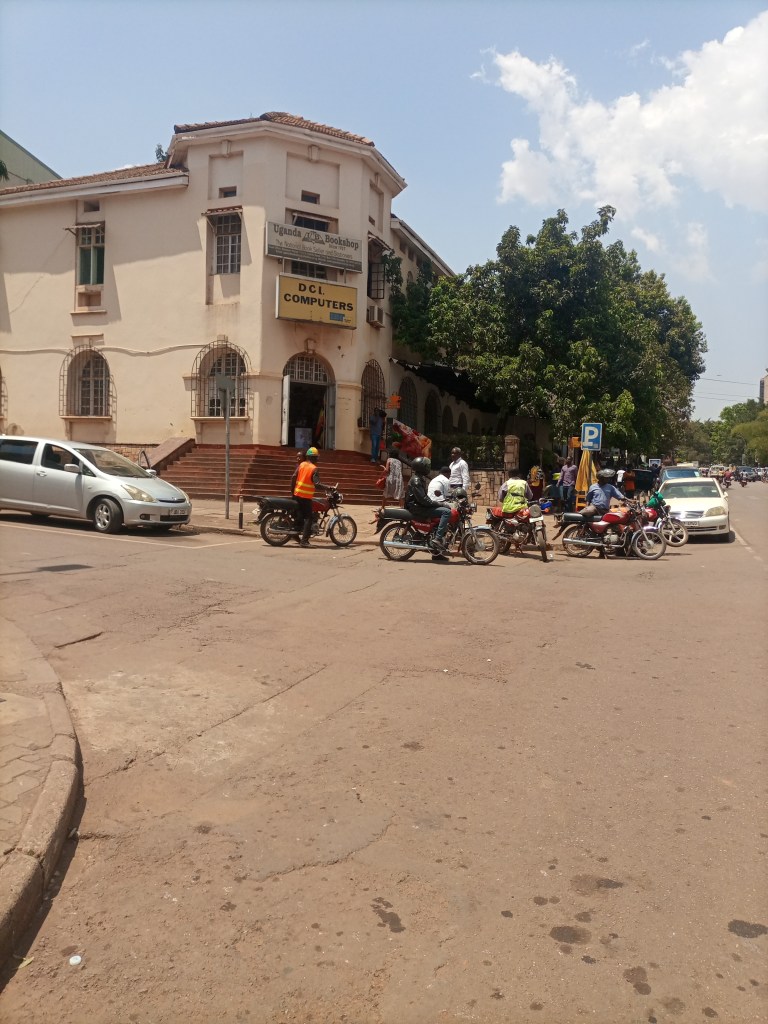
The oldest bookshop in Uganda located at Ebenezer House Plot 4 Colvile Street Kampala, Uganda.

There is one place that always makes me feel like a kid in a candy store; very excited, overwhelmed by choice and difficult to stop myself from looking around in fascination.
Amazingly, I still remember vividly when I first had that experience. I could have been six years old as my father held my right hand as we entered a huge place filled with books. Books of all sizes and colour. He knew exactly where we needed to go: The Children’s Books Corner. At one big table, there were many hardback books of the Ladybird Books series. Majority were blue in colour.
“ Look through and choose at least ten that we can buy for our home library,’’ he had offered me with a glint in his eyes.
My eyes had widened in surprise and wonder as Christmas had come early that year!
He had waited for me patiently as he looked through other bigger books at the next shelf.
As I flicked through the Ladybird books , I noticed that the faces of all the characters were white and the stories talked about Peter and Jane and their parents. I was overwhelmed by the choice and yet I managed to pick at least 12 of them. My father gladly paid for them all and an assistant carried them for us to the car, parked opposite the Central Police station. My siblings and I became regular customers of that book store. Visits to it were like a special treat for us. The home library expanded to include many other Children’s books.
As we grew older we came to know that the huge place was called the Uganda Bookshop
and our curiosity led us to find out much more about it. It was Uganda’s biggest bookstore, sold Bibles, Childrens’ books and many others and also supplied textbooks and scholastic materials to all schools in Uganda. It had regional branches across the country.
It had been started by a Church Missionary official by the name Mackay, the same Mackay of Mackay Martyrs church in Natete, the oldest church in Uganda. It started in Namirembe as a printery for the Anglican church ; printing Christian materials to ease the spread of Christianity in Uganda. By 1927, it had expanded to sell books and Bibles and had become the business arm of the church. Over time it became the main supplier of textbooks and scholastic materials to all schools in Uganda. This dominance was broken during 60s by the government of Milton Obote when it opened up the Uganda school supplies agency.
Uganda Bookshop limped on and during Amin’s time it diversified into selling and exporting Ugandan hand crafts as far as Italy. It has changed locations several times but I still remember that its Post office Box number was 145 for decades. Like Mary’s little lamb, my siblings and I followed it wherever it moved merely to buy books to read and be entertained.


As a teenager, I was a talented sports person and four of my other siblings.
I could run as fast as a hare so for many years I was a member of the school’s relay team,
220 yards race and long jump. For some years, our relay team dominated the national school championships held in the city’s national stadium every July. The winning was exhilarating but the Uganda Bookshop vouchers that the top 3 in each race were presented with, were the cherries on the cake. They ranged from 25 and 10 Ugandan shillings and with each one, you could buy several story books or a text book from the Bookshop. This fanned my culture of reading books for years. Little wonder that I am now writing fiction novels and short stories of my own!
I hardly think twice when buying a masterpiece novel or the autobiography of icons
like the late Nelson Mandela and fellow Ugandans like Rhoda Kalema and the late Joyce
Mpanga.


Then between 1962 and 2003 something incredibly exciting happened on the literary
scene: a collection of works by African writers; 359 books, was introduced on the literary scene by Heinemann Educational Books company of United Kingdom.
We started reading African stories written by Africans, stories we could easily relate to. African Literature at its best. First among these was Chinua Achebe’s THINGS FALL APART, which became a set book at
the O-level Cambridge school certificate exam.
In East Africa , first among these series was Ngugi wa Thiong’o’s WEEP NOT CHILD and Okot p’Bitek’s Song of Lawino and Song of Ocol . They were Colour-coded: Blue for nonfiction, Orange for fiction and green for poetry and drama. The series sowed the seeds for more emerging African writers.
Thankfully, my father never spared any money as we expanded our home library with these new gems.

As regular customers, we came to know some of the long-time assistants at the bookshop as friends
and the long-time serving manager, late Martin Luther Galiwango. Closing my eyes , I can see the big white, windowless van with the Uganda Bookshop emblem: an open book, parked outside the store.
Books opened my mind and imagination at a tender age and turned me into a global citizen long before the invention of the Internet followed by the World Wide Web.
The Internet opened up another option of Electronic books and Audio Books . I read them but still I prefer to touch and smell the Hard book as I turn over the pages.
By 1977, the old faithful bookshop had moved to its current corner: Ebenezer House Plot 4 Colvile Street
right in the Kampala city centre. It was rescued from a huge debt that almost put it under the auctioneer’s hammer, by the business mind-set of the late Archbishop Livingstone Nkoyoyo.
It has continued to run as the business arm of the Anglican church and has contributed towards the building of the Church house located in the city centre.


I last visited it in 1990 after the death of my father; this time round I was aggressively looking for the manuscript of my father’s autobiography in all printeries around Kampala. Since he was a member of the Anglican Church , Uganda Bookshop was the best place to start. Mr. Moses Mulwana, the long serving member of the bookshop was more than willing to help. After all, he had known my father well.
To our disappointment, it was not among the manuscripts which had gathered dust in the printery by then located in the basement. To this day the manuscript has never been found and yet my father had put a lot of energy and efforts to write and have it completed.
Thereafter, I went away in search of greener pastures for almost two and half decades and transferred my loyalty born out of the love of books, sowed in me by my late father and nurtured by my old school, to Bookstores in Botswana like Exclusive Books.
Having a zillion things to sort out after being away for long, combined with a radically changed Uganda and a city crowded with people, structures, cars and motorcycles, I had not yet touched base with one of my favourite pastime visiting places.


I was drawn to Uganda Bookshop in December 2024 after the launch of my father’s book: CRISIS IN BUGANDA 1953-55 the 2024 edition. The first edition was published in London in 1978.
Ugandan readers wanted to access it in a central place and no other place fitted that description than Uganda Bookshop.
I had no trouble locating the bookstore: same old location, almost the only old structure among the new high-rise buildings.
As I climbed up the ten red steps leading inside, I felt that I was returning to the old and familiar.
There were three young ladies; looking alike because of the braided hair and beige T-shirts and black skirts they were wearing.
I greeted them and asked them for directions to the manager’s office whose location I still remembered.
The place looked so small; could be due to the many shelves and tables of books. Two young tourists were browsing through the books as I made my way to the manager’s office through a narrow corridor.
In about forty minutes, I walked away with an agreement to supply my father’s book to the store and left five copies with the lady. Being me, I spent almost an hour browsing through the books. I was extremely thrilled to see many Christian books, short stories, fiction and nonfiction novels and biographies written by Ugandans-Ugandans telling their unique stories in their own voice to the world.

Curiosity led me to the back of the building and I was happy to note that the whole plot was intact apart from a few temporary small secretarial services , stationery booths and florists shops.
“ How did this prime plot survive being sold off or being newly developed?’’ I wondered out loud.

By late evening I had found out how it had survived. Ebenezer House is one of the few buildings in the city centre considered to be of historical significance and worth to be preserved by the city’s physical planning unit. It has to be maintained and kept looking historically accurate.


The church of Uganda continues to run the traditional bookshop but the bookshop has to be innovative to adapt and evolve to survive in the Digital era. It will have to go beyond book sales and evolve into a community space offering events, host events, book launches, workshops and authors book signings.
As for the loyal followers like me, the onus is on
us to write books and sell them in this bookshop as well as working with it to go out in schools to encourage the students to develop the reading culture early on in life.

There is no substitute for books in the life of a child.’’- May Ellen Chase
The greatest gift is a passion for reading.’’- Elizabeth Hardwick

QUESTION:

Are you among those who were enabled to develop the culture of reading books early on in childhood?
Are you passing on this beneficial culture to your children and other members of the community?

ORGANISING YOUR LIFE

A well-tended garden courtesy of AI

The beginning of each new year demands that each one of us pauses and reflects over the past one –

pick lessons from the failures and successes and apply them to inform the present and plan for the new year. The essence is planning to use your time effectively and efficiently for your personal and professional progress. This creates reasonable order and stability in your life amid the turbulence of the age.

It demands discipline to practice effective time management.

One has to consistently learn to prioritise what matters most to you in life, to prevent the URGENT from swallowing it up.

It’s the little details that are vital. Little things make big things happen.’’- John Wooden

Life Coach Michel Hyatt reminds us consistently that there are some high value tasks which support your key goals and if done right and on time, they will have a multiplier effect on your key goals.

From his experience, he advises the following:

 You identify 3-4 most important tasks of each day

  • The tasks should be clear, specific, and actionable
  • Stay focused on these tasks by using time blocks, dedicate time to a single task or a group of related tasks. 
  • Eliminate distractions like emails, social media texts while working.
  • Say “ NO’’ as a complete sentence to avoid anything that does not align with your goals.

Do it right every day and it adds up to weeks, months and before you know it, you have completed a full year!

“ Seasons change, and so do we.’’- B.K Borison

As each one of us adds another year to her/his life, we have to be mindful of the seasons of our lives relative to the seasons of our local environment.

The seasons in nature constantly remind us that things are changing. Each season gives you ideas to honour your intuitive nature.

The psychologists tell us that our emotions follow a similar cycle to that of the seasons of nature.

We should bask fully in the positive emotions like joy, happiness, hope and inspiration. These positive emotions create a protective buffering effect against the difficult times that we face later in life.

SUMMER- can be compared to being immersed in pleasurable experiences like walking in the wild , harvesting crops , dancing under a starry sky and other fun-loving activities. They add up to build a strong resilient armour within you.

AUTUMN- summer is long gone but you can still appreciate the beauty of the changing seasons and be transformed in a positive way.

WINTER- comparable to the difficult times that we go through in life. They fill us with fear, despair and worry. Our hope lies in knowing that they do not last forever.

 Time passes and seasons will come and go.

SPRING- the harshest winter is usually followed by a riotous spring. You recover from the hardships of the difficult winter. Rise from the ashes –stress, trauma and shock, you have experienced. Most times one comes out stronger and resilient.

A tree with strong roots laughs at storms.’’- Malay Proverb

As the years go by, you learn to look for the beauty and lesson in every season you experience.

You gradually learn the importance of order in life.

Order could be defined as a state of space where a system exhibits clarity, certainty or stability. It is a tool one needs to accomplish anything tangible in life.

 Order starts by recognising the priorities in your life and using available skills to do the things in the proper order.

Having order requires discipline and organisation in what you do and starts from within.

The psychologists believe that that an organised peaceful external life reflects one’s inner life while a disorganised external life reflects the chaos within.

Growing up in an organised environment of routine and cleanliness, children grow up to desire order as they mature. They tend to be responsible and dependable and prefer to live in orderly and organised surroundings.

 Children who grow up in a chaotic environment tend to have poor cognitive ability and poor language ability, tend to be less responsible, have less stimulation and develop problem behaviours.

Order in childhood has lasting effects on personality and behaviour.

Order creates the following effects:

  • It helps you get into a routine that reduces stress or feeling of chaos.
  • Boosts your self-confidence
  • Makes you more focused and productive and can save you money.
  • It enhances creativity
  • It improves your work-life balance.
  • Order improves your mental and physical well-being and helps you to feel more in control.

Some psychologists believe that there are seven key areas of one’s life that need to be organised and to flow in harmony so as to achieve life’s balance: a balance between work and personal pursuits.

1. Mental- intellectual growth and mental health

2. Spiritual – connecting with inner beliefs, values and sense of purpose.

3.Physical- the health state of your body.

4. Financial- income, savings and financial planning.

5. Personal-  you as an individual: your passions, interests and activities that bring you delight and pleasure

6. Family- your anchor that holds you through life’s storms and gives you a sense of belonging.

7.Career- work, achievements, professional growth and development.

To live a fulfilling and harmonious life, you have to balance work and personal life effectively. To most of us this work-life balance demands that we dance this delicate balance every day of our working life.

Life is like riding a bicycle . To keep your balance , you must keep moving.’’- Albert Einstein

From time to time, re-evaluate your PRIORITIES to set meaningful goals and intentionally improve areas that are lagging behind.

I vividly recall one time when I tried to play ‘ super woman’ ; taking on a post graduate course in Obstetrics and Gynaecology while at the same time starting a family. I nearly suffered burnout. I only saved myself by re-evaluating my priorities  at that moment in time. It worked wonders for me.

One other experience has been my return home after being away for almost 26 years.

Having grown up in an organised family, gone to a Church-founded school and later joined a profession which thrives on organisation, order and diligence ,many times I find myself almost losing my sense of control  due to the chaos around me. Both my creativity and productivity tend to be hampered and my energy drained in doing simple things like moving from point A to B!

There are times that I am like a derailed train!

What has kept me going is that there are still a few individuals who are still holding on to their core values of honesty, integrity, selfless service to their communities and just being decent human beings.

It is moments like this that make me appreciate the importance of order in life.

When Liberty destroys order, the hunger for order will destroy liberty.’’- Will Durant

“ For every minute spent organising, an hour is earned.’’- Anonymous

QUESTION:

At this moment in time, does each year added to your life make you more organised or disorganised?

How can you improve on this?


                             WALKING WITH ONE’S PAST

                             WALKING WITH ONE’S PAST

There are many old adages about the past, present and future- the standard markers of

 of time.

The past is behind, learn from it . The future is ahead, prepare for it . The present is here, live it.’’- Thomas  S. Monson

None of us can change the yesterdays, but  all of us can change our tomorrows.’’– Colin Powell

Tomorrow is often the busiest day of the week. – Spanish Proverb

One thing I know for sure is that as l live in the present moment, the past keeps showing up in snippets.

The psychologists tell us that unresolved issues in our past keep showing up and influencing the decisions and choices we make as adults.

The historians want us to look at everything through the lens of history since humans hardly change in behaviour and history helps us understand the complexities of human behaviour.

Looking at the past gives you perspective- understanding the complex circumstances of past events. It endows you with a broader perspective on current issues and challenges. It influences you to make better decisions and develop more effective solutions to the present.

Studying history helps each one of us to understand our own identities and cultures.

For the young generation, history presents them with real life dilemma, teaches them how to understand what it takes to overcome adversity and make a difference in the world around them. Students learn that acts of love, sacrifice, perseverance, integrity and commitment can impact the lives of many and inspire future generations to be bold and daring.

For the elderly, history helps us understand who we are, where we come from and the values that guide us. History adds depth to our present understanding and enhances senior identity.

In medicine, the health history is very crucial in understanding the patient’s state of health and most times it has a role in the diagnosis and management of each patient. Past medical history is essential in making timely and accurate diagnosis of an acute illness and leads to improved outcomes. It also helps in identifying the high risk of having common disorders and in the management of present health care and future needs of each patient.

In the current Digital era where things change often and rapidly, individuals and companies have to keep updating their profiles, systems and skills to survive and thrive.

For regular bloggers like me, we are to keep agile by writing content which is fresh , original  and relevant to keep our readers engaged and to attract new ones to our websites while retaining the old ones. Regular update is essential as new information becomes available and the writers gain new insights. Old content can also be refreshed.

 We should not to dwell in the past but we must strive to understand it with clarity and pick what is most appropriate to inform our Present and Future. For you when you know and understand things, you act better.

Those that fail to learn from history are doomed to repeat it.’’– Winston Churchill

 THE BOOK LAUNCH

An important historical event in the advance to Uganda’s independence took place in the six hundred years old Buganda Kingdom located in the current central Uganda. By then, it was being ruled by its 35th King: Kabaka Edward Mutesa II.

In 1945, after the second world war, the British empire and European countries were weakened by debts and needed to shed off some of their colonies and territories. The war armed the Africans with the military knowledge and leadership skills which they later used to fight for their own independence. African nationalism challenged the colonial powers and dismantled the empires.

By the time the British Prime Minister,  Harold Macmillan made his famous speech of “ the Wind of Change’’ in Cape Town , South Africa, in February 1960, the forces of change were blowing furiously across the African Continent.

From July 1953,  Kabaka Edward Mutesa II and his people had started clamouring for independence as a sovereign state from the her Majesty’s government.  The stalemate between the Kabaka and Queen’s representative as governor of the Uganda Protectorate, culminated in the exile of Kabaka Mutesa II to Britain on 30th November 1953. This was followed by two and half years of uncertainty and non-violent struggle against the Queen’s government by the Baganda.

Kabaka Mutesa II’s government was run by 3 Ministers: 2 Protestants and 1 Catholic. Among the  Protestants ones was my late father Paulo Neil Kavuma as the Katikkiro- Chief Minister. Educated in a Church missionary –founded school for chiefs followed by 20 years of working  in the Protectorate’s Provincial  and Resident’s Offices and 12 years as a saza chief in the Buganda Kingdom: he found  himself at the helm of the government.

 After the deposition of the Kabaka, the three ministers accepted to become regents – to rule the kingdom on behalf the Kabaka until his return. Together with their people, they chose to fight non-violently and relentlessly until the Queen’s government agreed to return Kabaka Mutesa II as their king on 17th October 1955.

It was a win-win situation for the Kabaka and his people and the Uganda Protectorate representing the Queen’s government in that for once the Buganda Kingdom agreed to become an integral part of the Unitary state of Uganda while Her Majesty’s government agreed to return Kabaka Mutesa II as Kabaka immediately and sign the new 1955 Buganda Agreement.

CRISIS IN BUGANDA 1953-55 is a personal account of my father as Katikkiro  at the vanguard of the fight for the return of Kabaka.  He wrote the manuscript in 1957 when everything was still fresh in his mind and it was published by Rex Collings, London 1979.

 Due to the civil turmoil  in the Uganda of the 80s, only a few copies were made available in Uganda.

Fast forward to the new millennium when our three children and a niece who were attending the University of Cape Town in science courses but voracious readers, stumbled upon CRISIS IN BUGANDA 1953- 55 in the African Region History section of their main library in 2007.  This challenged me as the eldest daughter of my father, to make the book available to Ugandans and the world at large.

 On returning to Uganda after almost twenty five years of economic exile in Botswana, Southern Africa,  I started on this project only to be slowed down by the two half years of the COVID-19 pandemic lock down. It took me a while to get assimilated into a radically changed Uganda.

By God’s grace , the 2024 Edition of the CRISIS IN BUGANDA 1953-55 was successfully launched at the very place: Butikkiro- the official residence of the Katikkiro of Buganda, where my late father had lived during that tough period of the exile of the Kabaka. By sheer coincidence, it was exactly 71 years since the historical event had happened! A group of invited guests closely connected to the book , members of our big family and friends were hosted for the launch by none other than the current Katikkiro of the Buganda kingdom: Owekitiibwa Charles Peter Mayiga.

The theme of the day was : Only Time Will Tell – that’s why my father wrote the book so that readers get to know the facts surrounding the saga to decide for themselves whether the 3 ministers led by him as Chief Minister made the right decisions at that moment in time.

THE  2024  EDITION INCLUDES

  1. The original book as my father wrote it and had it published in 1979.
  2.  Part of the Post Script is an introduction to the new edition by a renowned Ugandan Historian : Prof of History , Samwiri Lwanga- Lunyiigo
  3. A chapter entitled : After the Crisis in Mengo– introducing the young generation to Paulo Neil Kavuma and highlighting his great contribution to the growth and development of Uganda including his indispensable role in the NRA bush war in the Luwero triangle( 1980-86) and last but not least as a hands-on- father and as the true portrait of voluntary service in Uganda during his final thirty four years after the Mengo Crisis of 1953-55.

He died with a great sense of radical thankfulness and celebration of his whole life.

“ The dying pray at the last not ‘please’ but ‘ thank you’ as  a guest thanks his host at the door.’’

REVIEWS- One encouraging review from a reader under 40 :

“I finished reading Crisis in Buganda 1953-55 on Sunday.

What a thrilling book!

I was so engrossed in reading that book and found it most eye-opening and informative.

May your father’s legacy live on.’’

Where can I get the 2024 Edition of the book?

Locally:  Contact

+ 256 705164655 and + 256 784 859 642

For those outside Uganda and are interested in buying copies of the book please contact me via email address: janekavuma.kayonga@gmail.com

A tree without roots is a  piece of wood.- African proverb.

“ We are because he was.’’  He remains our best role model.

Communication

Communication between individuals and groups of people is a vital tool for understanding each other and opening up interpersonal problem solving pathways.
In today’s technology – driven world , instant or improved communication has resulted in miscommunication and misunderstanding.
When we use technology to communicate, we remove the the connection of emotions and body language.
We find ourselves not listening to understand but instead listen to reply and state our point of view without paying attention to understanding others.
Emojis, the digital language developed by the Japanese in the 1990s and became a form of communication from 2010 onwards facilitates this quick communication.
Like all languages, this Online Language keeps evolving and fast.
Now we have an EMOJIPEDIA where you can look up meanings of the different Emojis.
https: //emojipedia.org.

From this Emojipedia, the current most popular Emojis include:

The theme for my Blog is : Learning is for life so there is a lot of learning, unlearning and relearning to be done every day if we are to remain literate in this technology – driven 21st century. In this spirit, revisit an earlier post reflecting on communication.

GOING OUT ON A HIGH NOTE

GOING OUT ON A HIGH NOTE

This post was first published in 2017 and was updated on 11 August 2024

Usain Bolt at the 2017 Athletics World Championships at the Queen Elizabeth Olympic Park in Stratford

Image by William Warby from London, England, CC BY 2.0 , via Wikimedia Commons

30-year-old Usain Bolt, the Jamaican sprinter, is a 9-time Olympic gold medalist who shot into Olympic lore when he won 3 gold medals at the Olympics in Beijing, 2008. He is the fastest man in the world deserving of the nickname Lightning Bolt.

 I for one have always been fascinated by the Olympics and World championships since my teenage years. From the highs of  John Akii Bua’s gold medal, the first  for Uganda in the 400m hurdles in 1972 to  the scandal when Ben Johnson of Canada left the Seoul Olympics (1988) in disgrace-after testing positive for anabolic steroids following his gold medal in the 100m dash, the Olympics are an unparalleled showcase of excellence and human endeavor.  It has been a great joy and fun to watch Usain Bolt reinvent himself every year and keep challenging himself without using performance enhancing drugs. 

From the onset, Bolt identified his strengths and defined his image  that he projected to the world, then he committed fully to his authentic image and made the statement as the greatest athlete of all time. Every time he stepped on the field to compete, he  carried himself with dignity and respect thus teaching us how to treat him. He owned his image, loved it and lived it. Who can forget how he worked up the London crowd during the 2012 Olympics after winning the 100 metre race?! He covered himself with the Jamaican flag and ran around the stadium greeting his fans! No wonder the people of Jamaica adore him and consider him among the best representatives of their country. On the track, he demonstrated incredible skills, traits, abilities  and strived to play by the rules. He set himself apart from every other athlete and could never be confused with any of them.He declared to us that he was the fastest man in the world and proved it. He had become such an essential part of the Olympics and World championships and since his retirement , we continue to miss him until someone steps up to follow in his footsteps.

He was bold enough to say : “I’m the best.  I’m the fastest man alive. I’m now a legend.’’

I was inspired to write this post mainly out of my admiration of him as one of the all time greats but at the same time for his humility that allowed him to know when to quit the game.

According to the Institute of Biomedical Research and Sports Epidemiology; the peak age performance for athletes in track and field events is 26.1. For the 100 metre race, it is 25.4 for men and 26.6 for women. In such a high-powered activity, no one gets better with age. Bolt holds the world record both in 100 metres dash (9.58secs of 2009) and 200 metre race (19.19 secs of 2009)  and chose to give himself the 2017  IAAF World Championships in London as his final challenge. He had hoped to go out on a high note by breaking his own 100 metre record.   In a highly charged atmosphere, the unexpected happened: Usain Bolt followed behind Christian Coleman (USA) and Justin Gatlin(USA) , the only person who had beaten him twice before. Justin Gatlin had been banned twice for doping and returned with a big bang. The irony was that as Bolt bowed out, Gatlin staged a comeback.

Like all his fans, I very much wanted Bolt to win one more time. 

 After all,we are always being advised to leave the stage when the audience is still applauding.

Some inspiring quotes by Usain Bolt:

“ Stop waiting for things to happen. Go out and make them happen.’’

“To all my doubters, thank you very much because you also pushed me.’’

“The difference between the impossible and possible lies in determination.’’

Yes, Usain Bolt, you took the games to another level; you made them exciting and made people want to watch them . Most importantly, you have inspired and demonstrated to the young that each one has something great inside her or him and has the responsibility to develop it fully for their own good and for the good of others. You set out to be recognized among the greats like Mohammed Ali and Pele and you achieved it.  I cannot wait to see you channel that deep passion, energy and determination into something else.

Fast Forward to August 2024.

The doctor in me has forced me to follow up Usain Bolt’s life after he hung up his sports shoes at the  London  IAFF World Championships of 2017. He had bagged a bronze medal in the 100m men’s race but still retired as the track legend and the wealthiest sportsman in track and field. He was 31 years of age. Since the age of 16, he has enjoyed sponsorship by PUMA, the sportswear company. Usain Bolt has made PUMA a lot of money by his iconic status while he is paid a minimum of $ 10 m per a season, with another $10m added for the start of 2017 World Championship.

 Life after a high profile sports career.

Available information indicates that his coach had wanted him to stage a comeback but knowing himself better , Usain, never did. He instead had a short stint at his favourite game, football till 2019.

After his retirement in 2017, he continued to collect $ 4m per year as PUMA’s brand ambassador. He also signed endorsement deals with other brands like VISA. His charisma and larger-than life personality draws large audiences whenever he appears at any event. He earns large appearance fees at any event.

Virtual appearances are the lowest while athletic appearances range from$ 200,000-400000.

He has a management team that maximizes his earning potential as the man with the most unmatched athletic performance worldwide.

He is engaged in business and some philanthropic efforts.

In his personal life, he started a family with his girlfriend of over a decade: Kasi Bennet.

They had their first child, a daughter, in 2020 followed by twin sons in 2021. He is committed and focused on being a hands-on head of the family and hands-on father.

He tries to live a normal life though his fame throws him some restrictions.

As for the 33rd  Summer Olympics that started in Paris on the 26th July and ending on the 11th August 2024, the sports fans are on a daily high as surprises keep rolling in.

Noah Lyles won gold in the 100m event in 9.784 seconds and Letsile Tebogo from my second country, Botswana, won gold in the 200 m event in 19.46 seconds , setting an African record. This was Botswana’s first gold medal at the Olympics so it was not surprising at all when the President of this country, known for its high quality diamonds, declared Friday a half- holiday to celebrate the success.

Usain Bolt’s world records (of 9.58 seconds in the 100m event and 19.19 seconds for the 200m event are unbroken, proving that Usain Bolt remains the fastest man in history.

As a Ugandan, I screamed with delight when Joshua Cheptegei won gold in the men’s 10000m event and Peruth Chemutai bagged silver in the women’s 3000 m steeplechase.

One last quote from Lightning Bolt:

I know what I can do so it doesn’t bother me what other people think or their opinion about situations.’’

No wonder the self-belief, discipline, determination, hard work, resilience and adaptability that turned a 

16-year-old Jamaican boy into a world athletic icon, still guide him into being his own man.

QUESTION:

There is always life after a career, however simple. Has Usain Bolt’s resilience and adaptability to life after a high profile career helped you find strength in managing change and embracing new challenges?

Has it given you some ideas on how to turn your personality into influence and inspiration?

MAKING DECISIONS IN LIFE

At the Crossroads: courtesy of pixy.org

MAKING DECISIONS IN LIFE

Life’s journey is created by a collection of decisions made every day. Each one of us makes countless decisions which when added together possess incredible power over our lives.

We ‘re our decisions.’’– Prof Salem Al Shereida

The quality of life is  built on the quality of your decisions.’’ – Wesam Fauzi

Nothing is more difficult, and therefore more precious than to be able to decide.’’- Napoleon Bonaparte

“Decision making is easy when your values are clear.’’– Roy Disney

“Sometimes you make the right decision, sometimes you make the decision right.’’– Phil McGraw

“The best decisions are not made with your mind, but with your instinct.’’- Lionel Mess

A decision can be defined as a conclusion or resolution reached after thinking through of the benefits and costs and considering short term and long term consequences.

Choice is the purest expression of free will but it can be difficult because it also represents sacrifice.

The choices we make determine and shape our decision making process and therefore are key to whom we are to ourselves and to others. Every choice made impacts our lives positively or negatively. These choices are key in determining our level of success, happiness and fulfilment.

There are some significant, life-changing decisions – the ones that seem to hold the keys to our future.

These tough decisions include:

1.Choosing a career

2.Pursuing an education

3. Choosing a life partner.

4.Managing the finances

5.Taking calculated risks

    Decisions on these major five aspects of our lives have a huge impact on our overall success and happiness in life.

    The decisions made are never written in indelible ink but can be changed especially when faced with the need to change- to open up to new opportunities and be willing to adjust your goals and plans. In pursuit of our personal and professional growth, we have to be ready for challenges at each stage of our lives. Resilience and determination help us to overcome obstacles and succeed.

    Surprisigly, it is the smallest decisions that we make every day that hold significance.

    Some of them like changing where you live could have a multiplier effect to almost all aspects of the life you are creating.

    Data from cognitive research on human beings and chimpazees shows that

    human beings have evolved over millions of years to develop a bigger and advanced brain especially the front lobe and cortex to enable them to think and remember. Our brains are approximately 3-4 times that of our closest relatives: the chimpanzees, while they share about 99 percent of the human genetic material (DNA) . Our brain is about 2 percent of our body weight and consumes 20 percent of the total body energy and oxygen. It is highly connected and active thus enhancing our cognitive ability. It also allows us to have specialised functions as language, tool making and reasoning.

    The human cognitive function is fully functional between 25 and late 40s.

    It this highly developed and intricately connected brain that allows us to learn and understand what we have to learn and to create analogue memories to recall and connect to the new memory.

    During this structured process, we form opinions, choose actions through our mental processes as informed by the brain, reason, emotions and memories.

    This enables us to weigh the benefits and costs of our choices and whether we can cope with the consequences.

     “Decision making is a sharp knife that cuts clean and straight ; indecision , a dull one that hacks and tears  and leaves ragged edges behind it. ‘’ – Gordon Graham

    You can’t make progress without making decisions.’’– Jim Rohn

    The psychologists believe that effective decision-making involves striking a balance between what the mind has evaluated as logical and what our emotions consider as our desires and preferences.

    After identifying and defining the exact issue at hand, the psychologists advise you to consider these basic principles to reach a decision:

    1. Clarify your values and principles- what matters most to you. Understanding your values enables you to evaluate your choices and align them to your core values.
    2. List the options available to you at that moment in time
    3. Write down the pros and cons of each option
    4. Step outside your comfort zone and think about the long term implications.
    5. Trust your instincts -rational analysis and logic are crucial but consider too the power of your intuition- gut feeling. Do this for each option to reach a choice that resonates with you at a deeper level. Sometimes the subconscious can pick on a detail that our conscious mind misses.
    6. Embrace the uncertainty-  rarely does one get to make the ‘’perfect choice’’, each decision is tagged with trade-offs. Sometimes you just make the right decision other times the best you can do is to gather the information, trust your instincts and move forward. Even if you make the wrong choice, later you can analyse it and learn from the experience.
    7. Practice Decision –making. It is a skill so like any other skill, you have to keep practicing to become better at it. Start with small decisions and move to bigger ones; that way you build your confidence and inspiration.

         “ There’s no wrong time to make the right decision.’’- Dalton Mc Guinty

    Looking back at my own life, I strived to make the right decisions but also made wrong decisions and some of them have stayed with me.

    One major one, was deciding to become a doctor to help people, when I was about eight years old. Being an all-round student, it saved me from being pushed into the A-level Arts class by my teacher of English and literature.

    To have decided to leave for greener pastures in Botswana mainly to get better opportunities for our personal and professional growth while at the same time opening up better opportunities for our three children.

    My decision to give up private practice in Botswana and instead return to start afresh in Uganda while taking good care of my octogenarian mother has paid huge dividends to the two of us.

    I vividly recall one small decision that ruined our day in the 90s. My late husband and I drove my young sister to catch an early flight the United Kingdom. Close to Entebbe airport, a traffic policeman waved us down . I convinced my husband not to stop but to deal with the policeman on our return. My sister got on the plane in good time but my husband, a surgeon, never touched a patient on his theatre list for the day. He never left the Entebbe magistrate’s court until 4pm, after paying a hefty fine!

    “Life is about choices. Some we regret, some we’re proud of. Some will haunt us forever. The message, we are what we choose to be.’’- Graham Brown

    As a senior citizen, I truly know whom I am : truly authentic, having been liberated  of conformity and masks. I choose courage over fear and self-awareness over societal expectations. My choices are more genuine than when I was :

    30-45 thrived on work and status

    45-65-the age of mastery- finding your voice to assert yourself, focusing on being independent. Clear about who you are. Doing what you feel is right and what is your own to do.

    65-85+  – The age of integrity, of new pursuits while fully emancipated. Repossessing your intellectuality and originality.

    Authenticity-fully embracing one’s true self: unique qualities and imperfections, comes to us late in life usually after 50 years of age. After learning to trust your inner voice or intuition, you tap into its inner wisdom daily.  It helps you find clarity amidst the myriad of distractions in a fast-paced world. The consequence is that you live the life you love, a life lived with purpose and meaning. A life in alignment with your innate nature.

    As we grow older we become clear on what matters most to us in life and understand the unseen forces that drive the majority of our daily decisions. It translates into living the life you love one day at a time- turning your dreams into reality on a daily basis.

    Authenticity is the daily practice of letting go of who we think we’re supposed to be and embracing who we are.’’ – Brene Brown

    QUESTION:

    Do you realise that being unapologetically yourself is one of the key unseen forces that drive the majority of your daily decisions which themselves result in your living a fulfilled life?