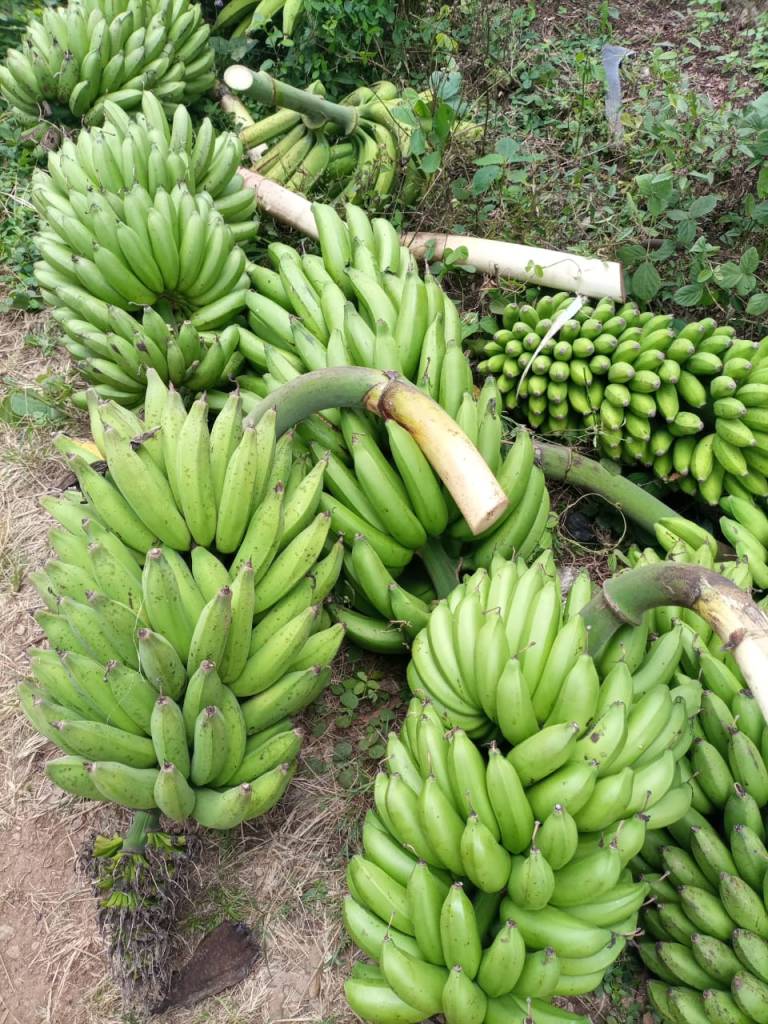
The first fruits of the first rains this season.
The rains revive the plants and the plants keep giving to us cheerfully.
I do not remember any occasion when my mother came to our place empty-handed or my late father
ever forgot to send me a cheque or a small token on my birthday. My mother has always had green
fingers and my father loved sharing what he had because he believed that life was richer if shared with
others.
Balanced generosity was one of their badges of honour- they gave us because they felt it was the right
thing to do and because they wanted to. That was them. Today at 93, my mother still asks us to give a
glass of water and something to eat to anyone who calls on her : be it her doctor, village Catholic priest,
praying group or grandchildren. They have all learned to be comfortable with her offers and take them
gladly.
I grew up in a community where the village collectively raised the children, buried their own, looked
after their needy and celebrated their successes together. These glued the community together.
However, things have changed over the years leaving families to shoulder most of these responsibilities.
I have noticed changes in the patterns of giving to one another: giving to gain a favour, to get something
in return and the politicians giving to have control or manipulate the ordinary citizens. Those giving to
make a difference to people’s lives are in the minority!
As a senior citizen, I have suffered many demands on my time, efforts, knowledge and experience and
my money too. This is mainly due to the fact that currently, the basic essential services like health care
and education have huge gaps in them. Many times I have found myself losing myself in giving to others.
I was forced to stop and think deeply about the demands being made on me and design my own
solutions to preserve my sense of self.
It drove me to read thoroughly and try to understand the psychology of giving.
I felt I should share the gems I picked from this wide reading with you.
Generally, the different forms of generosity are driven by different motives.
MEANINESS/STINGINESS
No doubt this is the opposite side of giving but it is considered as one extreme on the spectrum of
GIVING. I know for sure that givers cannot quench the thirst of every person around them but at the
same time , there are people who are reluctant to spend money on others even on themselves or basic
necessities in life in order to hoard money or other possessions. The psychologists tell us this behaviour
is born out of emotional insecurity. They live with the fear of not being able to meet their needs in
future so they cling to everything they have: money or possessions.
Some of them have lived through trauma or emotional deprivation early on. Over time, they develop
unhealthy coping mechanisms to protect themselves. Hoarding gives them control and is their way of
protecting themselves against emotional distress.
As they are constantly consumed by the fear of running out of resources they become emotionally
withdrawn and detached from others. A number of them go on to develop anxiety disorders, depression
or obsessive compulsive disorders.
They need help to break this cycle of hoarding by gradually changing their mind set from obsessive
preservation of resources to sharing and investing in oneself and others.
Their management starts from identifying the underlying root cause of stinginess.
They are then taken through a process of learning to practice generosity with time, energy and
emotions. Life is richer if shared with others.
Genuine giving is itself born out positive traits like empathy, kindness and helpfulness.

Ripe plantain tastes better when shared
- ENDLESS GIVING – excessive generosity that prioritises the needs of others over your own to avoid
conflict or rejection.
It is rooted in poor self-esteem- in a desire to please others or to seek validation.
It has a tendency to trap the giver into a cycle of giving beyond her/his means and can easily cause
emotional, mental and physical burnout- exhaustion.
Your endless generosity can turn the willing takers into dependants on your generosity and gradually
drains you.
In some cases, recipients tend to abuse the givers generosity and become exploiters.
Over time the giver loses energy, time, empathy to give meaningfully to those who genuinely need
her/his generosity.
Psychologists and Counsellors manage these kind of givers by:
helping them to understand the healthy approach of building self-worth and to shed off fears of
disappointing others.
Teaching them to consider themselves first – never to empty their emotional bank account
To give out of choice rather than compulsion. To keep at it until they learn the habit. It
demands a lot of patience, practice and learning on their part. In the long run, it brings
refreshing balance to their lives.
The rural African woman has been conditioned by society to give to the family and community without
considering herself. I have seen them give until they have nothing left to give to themselves and others.
Families and communities have the duty to rescue them from this forced preoccupation of giving,
nurturing and pleasing others at their expense, by teaching them their value as individuals.
- BALLANCED GIVING: The capacity to give out of a conscious choice not out of obligation. You balance
your own needs with the needs of others. Thankfully, this is where most people fall on the spectrum of
giving.
You give because you feel that it is the right thing to do. You use your intuition to comprehend the
requests for help and choose how to respond to each one. It is learned over time and one should work
on it to sustain it. You become a better version of yourself with practice.
MOTIVE- a healthy approach to giving: true giving from the heart. Giving from a deep well of love,
concern and care without maiming yourself or the recipient. You have clear boundaries and you stick to
them for your own good without feeling guilty about it. You respect your intuition.
You know that it is fine to say:
I am not in a position to help
I need time to consider it
I can only go this far with your request for now.
This is the last time I am helping out so rise up and help yourself
I know you can do this for yourself so go ahead and have it completed.
Communicate your limits clearly and live by them.
Naturally, these lines are sometimes blurred in our lives and we allow ourselves some flexibility
depending on the situation and the person you are trying to help. But one should be reminded that
choosing one’s response based on your intuition is very liberating.
SOME QUOTES AND PROVERBS ABOUT GIVING.
You don’t have to be an angel, just be someone who can give.”- Patti Labelle
Ekisa ekitagaana kizala obulimba- Luganda proverb
Literally meaning : if you keep promising things without limits, you become a liar.
Ekisa kitta n’enge etta
Too much kindness /generosity can cause more harm than good
Entasiima ebula agiwa
An ungrateful person will in the long run out of givers.
If you eat alone, you will die alone. Kikuyu Proverb
If a husband is stingy, it is likely that his father is stingy.- Kikuyu Proverb
If you have some savings you will not go hungry- Kukuyu Proverb.
Okuddiza guba mwoyo- Luganda proverb.
You do not have to be rich to give, it all comes from the heart.
“ You give but little when you give of your possessions. It is when you give of yourself that you truly
give.’’- Kahlil Gibran
“When you give cheerfully and accept gratefully, everyone is blessed.’’- Maya Angelou
“Giving opens the way for receiving.’’- Florence Scovel Shina
2 Corinthian 9:7 “You should each give ,then, as you have decided, not with regret or out of a sense
of duty; for God loves the one who gives gladly.’’
Everyone has something to give- time, attention, a listening ear, care, affection, support, a simple smile
or material possessions.
“Everyone wants to be something or someone but no one can just be.’’- Unknown
QUESTION:
Has this post helped you learn about yourself as a giver?

 apagefrommunakusbook