Part 1
The two and half decades that I worked in Botswana, a country three times my country Uganda and 70 percent of its territory is the Kalahari Desert, I learned to treasure water, use it sparingly and to recycle it. Even up to today I keep a permanent bucket in my kitchen to collect clean water used for washing vegetables or rinsing utensils for watering plants and trees in the kitchen garden and compound.
In a desert, water is life- part of food security, increases productivity in agriculture, energy and industry.
I quickly picked the 3Rs of the best practices of sustaining our environment namely: REDUCE, REUSE
and RECYCLE.
I arrived in Botswana during the severe drought of 1990-1995. I never saw a drop of rain until six months later! Very weird for a person born and raised at the Equator.
On my return to Uganda, I have come to realise that there have been a lot of changes in the weather patterns and the day to today minimum and maximum temperatures. The rainy seasons are no longer as predictable as they used to be while I was growing up in the 60s and 70s. The two rainy seasons in the Central region used to be March to May and then September to November. Now Uganda experiences short, heavy rains and harsh droughts especially in the Eastern and North –Eastern Uganda.
These changes demand for reliable water management, opening up irrigation schemes to ensure food security and productivity, effective and efficient use of water for energy and industry.
The climatic changes are mainly due to a scientifically proven concept of Global warming- the warming up of the earth’s surface through the greenhouse effect by increased levels of Carbon dioxide gas and other greenhouse gases like Methane and Nitrous oxide in the atmosphere. The gases trap the sun’s heat causing warming and this in itself results in climate change.
Available information shows that as early as 1896, Swedish scientist: Svante Arrhenius, first predicted how the increasing Carbon dioxide gas levels in the atmosphere were substantially altering the surface temperatures through the greenhouse effect.
In 1938, Guy Callendar had concluded that the increase of Carbon dioxide in the earth’s atmosphere had continued to cause global warming.
1988 was recorded as the hottest year on record with widespread drought and wildfires in the USA. The changes were mainly due to global warming.
The increase in the greenhouse gases was due to human activities namely:
- Burning of fossil fuels like coal, oil, gas for energy-responsible for 90 percent of Carbon dioxide emissions in the atmosphere.
- Deforestation
- Industrial emissions
- Increased agriculture and livestock farming
- Waste and landfills.
- Use of industrial chemicals.
Generally, 20 percent of global warming is a result of deforestation.
Most of us could remember what we were taught in a biology class: how green plants made the sugar that they need for energy and building other essential molecules by the chemical process known as PHOTOSYNTHESIS. During this process, green plants, algae and some types of bacteria trap the sunlight energy and use it with water and Carbon dioxide gas to form carbohydrates(sugars) and release Oxygen, vital for the survival of life, as a by-product.
In this process, the plants remove the Carbon dioxide from the air while the Oxygen forms the ozone layer which protects living organisms from high –energy ultraviolet (UV) radiation from the sun.
As the world’s population increases, more land is cleared of trees to create space for building houses, factories, commercial agriculture and as fuel for cooking and heating.
In Uganda, trees are cut down mainly for agricultural expansion and to use as firewood and charcoal-the main source of energy for most ordinary people. Forest reserves have been encroached upon.
As forest land is being converted for economic purposes, not many trees are being planted so this has led to fast accumulation of Carbon dioxide gas in the air leading to fast global warming.

https://www.climate.gov claims that the earth’s temperature has risen by an average of 0.06 degrees Celsius /0.11F per decade since 1850.
The main effects of climate change:
The increase in temperatures are causing ice sheets and glaciers to melt especially at the poles and has resulted in the rise of sea levels, floods and displacement of communities and the disruption of ecosystems.
Even the snow and glaciers on the Rwenzori Mountains known as the Mountains of the Moon at 5,109 metres and close to the Equator in Western Uganda, are progressively shrinking. Lake Victoria levels tend to be increasing more so during the short but heavier rainy periods.
I grew up in a green Kampala city, built on the traditional seven hills but now, when I walk in the city, I can easily count the trees standing! The oldest tree (70 years+) could be the Mvule tree at Namungoona opposite the Main Greek Orthodox Church along Hoima Road.
The seven hills have expanded to 22+ hills all covered by residential houses, hardly any green area.
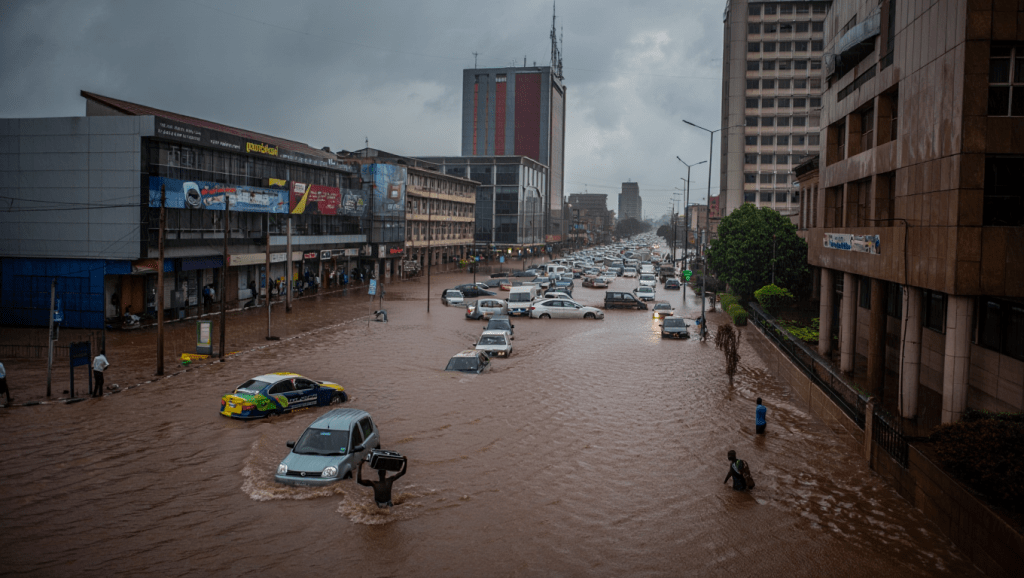
Deforestation and warm temperatures cause extreme weather patterns/events: flash floods and severe drought. Since the 1990s, Kampala has suffered flash floods which seem to be getting heavier over the years.
On the 26th March 2025, just after the searing heat of February, it took only two hours of relentless rain to flood the city and surrounding areas. The roads became impassable; the drainage channels were blocked. Movement had to be minimised for safety and by the end of day, seven people were reported dead and a lot of damage had been caused on property and businesses.
Other areas like Lugazi (about 46 kilometres east of Kampala) suffered floods too.
The rainy season has just begun. We all fear what could happen next as far as preparedness and response are concerned.
END OF PART 1
To be continued…….
QUESTION:
How are you participating actively in stopping the polluting of the environment in your community?
A clean, safe environment starts with you and I.

 apagefrommunakusbook