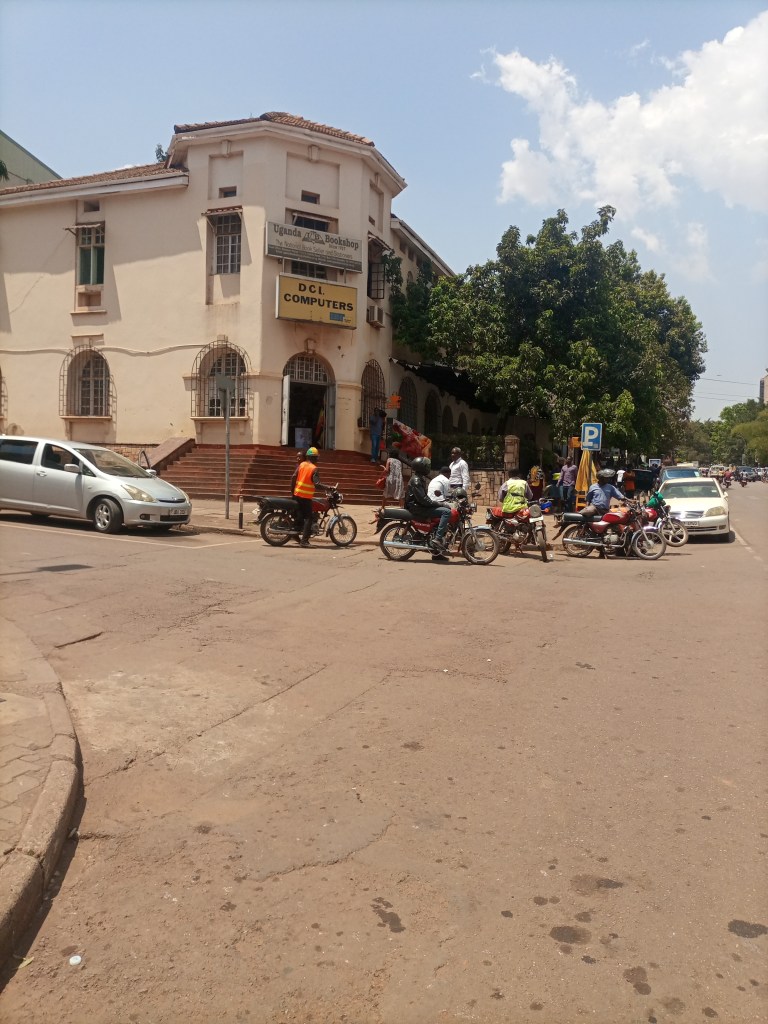
The oldest bookshop in Uganda located at Ebenezer House Plot 4 Colvile Street Kampala, Uganda.
There is one place that always makes me feel like a kid in a candy store; very excited, overwhelmed by choice and difficult to stop myself from looking around in fascination.
Amazingly, I still remember vividly when I first had that experience. I could have been six years old as my father held my right hand as we entered a huge place filled with books. Books of all sizes and colour. He knew exactly where we needed to go: The Children’s Books Corner. At one big table, there were many hardback books of the Ladybird Books series. Majority were blue in colour.
“ Look through and choose at least ten that we can buy for our home library,’’ he had offered me with a glint in his eyes.
My eyes had widened in surprise and wonder as Christmas had come early that year!
He had waited for me patiently as he looked through other bigger books at the next shelf.
As I flicked through the Ladybird books , I noticed that the faces of all the characters were white and the stories talked about Peter and Jane and their parents. I was overwhelmed by the choice and yet I managed to pick at least 12 of them. My father gladly paid for them all and an assistant carried them for us to the car, parked opposite the Central Police station. My siblings and I became regular customers of that book store. Visits to it were like a special treat for us. The home library expanded to include many other Children’s books.
As we grew older we came to know that the huge place was called the Uganda Bookshop
and our curiosity led us to find out much more about it. It was Uganda’s biggest bookstore, sold Bibles, Childrens’ books and many others and also supplied textbooks and scholastic materials to all schools in Uganda. It had regional branches across the country.
It had been started by a Church Missionary official by the name Mackay, the same Mackay of Mackay Martyrs church in Natete, the oldest church in Uganda. It started in Namirembe as a printery for the Anglican church ; printing Christian materials to ease the spread of Christianity in Uganda. By 1927, it had expanded to sell books and Bibles and had become the business arm of the church. Over time it became the main supplier of textbooks and scholastic materials to all schools in Uganda. This dominance was broken during 60s by the government of Milton Obote when it opened up the Uganda school supplies agency.
Uganda Bookshop limped on and during Amin’s time it diversified into selling and exporting Ugandan hand crafts as far as Italy. It has changed locations several times but I still remember that its Post office Box number was 145 for decades. Like Mary’s little lamb, my siblings and I followed it wherever it moved merely to buy books to read and be entertained.
As a teenager, I was a talented sports person and four of my other siblings.
I could run as fast as a hare so for many years I was a member of the school’s relay team,
220 yards race and long jump. For some years, our relay team dominated the national school championships held in the city’s national stadium every July. The winning was exhilarating but the Uganda Bookshop vouchers that the top 3 in each race were presented with, were the cherries on the cake. They ranged from 25 and 10 Ugandan shillings and with each one, you could buy several story books or a text book from the Bookshop. This fanned my culture of reading books for years. Little wonder that I am now writing fiction novels and short stories of my own!
I hardly think twice when buying a masterpiece novel or the autobiography of icons
like the late Nelson Mandela and fellow Ugandans like Rhoda Kalema and the late Joyce
Mpanga.
Then between 1962 and 2003 something incredibly exciting happened on the literary
scene: a collection of works by African writers; 359 books, was introduced on the literary scene by Heinemann Educational Books company of United Kingdom.
We started reading African stories written by Africans, stories we could easily relate to. African Literature at its best. First among these was Chinua Achebe’s THINGS FALL APART, which became a set book at
the O-level Cambridge school certificate exam.
In East Africa , first among these series was Ngugi wa Thiong’o’s WEEP NOT CHILD and Okot p’Bitek’s Song of Lawino and Song of Ocol . They were Colour-coded: Blue for nonfiction, Orange for fiction and green for poetry and drama. The series sowed the seeds for more emerging African writers.
Thankfully, my father never spared any money as we expanded our home library with these new gems.
As regular customers, we came to know some of the long-time assistants at the bookshop as friends
and the long-time serving manager, late Martin Luther Galiwango. Closing my eyes , I can see the big white, windowless van with the Uganda Bookshop emblem: an open book, parked outside the store.
Books opened my mind and imagination at a tender age and turned me into a global citizen long before the invention of the Internet followed by the World Wide Web.
The Internet opened up another option of Electronic books and Audio Books . I read them but still I prefer to touch and smell the Hard book as I turn over the pages.
By 1977, the old faithful bookshop had moved to its current corner: Ebenezer House Plot 4 Colvile Street
right in the Kampala city centre. It was rescued from a huge debt that almost put it under the auctioneer’s hammer, by the business mind-set of the late Archbishop Livingstone Nkoyoyo.
It has continued to run as the business arm of the Anglican church and has contributed towards the building of the Church house located in the city centre.
I last visited it in 1990 after the death of my father; this time round I was aggressively looking for the manuscript of my father’s autobiography in all printeries around Kampala. Since he was a member of the Anglican Church , Uganda Bookshop was the best place to start. Mr. Moses Mulwana, the long serving member of the bookshop was more than willing to help. After all, he had known my father well.
To our disappointment, it was not among the manuscripts which had gathered dust in the printery by then located in the basement. To this day the manuscript has never been found and yet my father had put a lot of energy and efforts to write and have it completed.
Thereafter, I went away in search of greener pastures for almost two and half decades and transferred my loyalty born out of the love of books, sowed in me by my late father and nurtured by my old school, to Bookstores in Botswana like Exclusive Books.
Having a zillion things to sort out after being away for long, combined with a radically changed Uganda and a city crowded with people, structures, cars and motorcycles, I had not yet touched base with one of my favourite pastime visiting places.
I was drawn to Uganda Bookshop in December 2024 after the launch of my father’s book: CRISIS IN BUGANDA 1953-55 the 2024 edition. The first edition was published in London in 1978.
Ugandan readers wanted to access it in a central place and no other place fitted that description than Uganda Bookshop.
I had no trouble locating the bookstore: same old location, almost the only old structure among the new high-rise buildings.
As I climbed up the ten red steps leading inside, I felt that I was returning to the old and familiar.
There were three young ladies; looking alike because of the braided hair and beige T-shirts and black skirts they were wearing.
I greeted them and asked them for directions to the manager’s office whose location I still remembered.
The place looked so small; could be due to the many shelves and tables of books. Two young tourists were browsing through the books as I made my way to the manager’s office through a narrow corridor.
In about forty minutes, I walked away with an agreement to supply my father’s book to the store and left five copies with the lady. Being me, I spent almost an hour browsing through the books. I was extremely thrilled to see many Christian books, short stories, fiction and nonfiction novels and biographies written by Ugandans-Ugandans telling their unique stories in their own voice to the world.
Curiosity led me to the back of the building and I was happy to note that the whole plot was intact apart from a few temporary small secretarial services , stationery booths and florists shops.
“ How did this prime plot survive being sold off or being newly developed?’’ I wondered out loud.
By late evening I had found out how it had survived. Ebenezer House is one of the few buildings in the city centre considered to be of historical significance and worth to be preserved by the city’s physical planning unit. It has to be maintained and kept looking historically accurate.
The church of Uganda continues to run the traditional bookshop but the bookshop has to be innovative to adapt and evolve to survive in the Digital era. It will have to go beyond book sales and evolve into a community space offering events, host events, book launches, workshops and authors book signings.
As for the loyal followers like me, the onus is on
us to write books and sell them in this bookshop as well as working with it to go out in schools to encourage the students to develop the reading culture early on in life.
“There is no substitute for books in the life of a child.’’- May Ellen Chase
“The greatest gift is a passion for reading.’’- Elizabeth Hardwick
QUESTION:
Are you among those who were enabled to develop the culture of reading books early on in childhood?
Are you passing on this beneficial culture to your children and other members of the community?

 apagefrommunakusbook