Ngugi wa Thiong’o is considered to be East Africa’s leading novelist.
By sheer coincidence, he is a graduate of Makerere University College of the early 60s and has been writing since then.
His first novel: Weep Not Child was published in May 1964 !
Like in any other industry, writers grow over time; maturing to become society’s influencers and catalysts of change.
A book or a short story that a writer writes and publishes at a particular moment in time, reflects the overall maturity of that person and how he/she interprets society at that moment. One good reason to keep writing.
As Ngugi wa Thiong’o clearly puts it in these quotations:
“Write write write again , and you will get it right.’’ In short: write and write makes it right.
“All that mankind has done, thought, gained or been; it is lying as in magic preservation in the pages of books.’’
Writing is a skill that requires a tremendous amount of practice to become the best of the best.
The writer Malcom Gladwell popularised the 10,000-hour rule of guided practice for anyone to become a master of a skill.
I have been running a personal blog since 2016; to hone my writing skills, to build up a readership base and to connect with writers. I use my wealth of knowledge, skills and experiences to impact readers in my small way. Getting feedbacks from writing groups and readers has helped me tremendously to grow as a writer.
I attend writing workshops and conferences in my quest to become a master. Last week I attended a three days’ international conference to celebrate Abdulrazak Gurnah as the first East African writer to win the Nobel Literature Prize (2021). It was organised by the Uganda Women Writers’ Association- FEMRITE, founded in 1995.
I consistently take part in writing competitions like the Commonwealth short story competition. It pushes me to write to a wider, diversified audience. It takes me out of my comfort zone.
I am a member of several Online writing cartels like The Write Practice, Yours2 Read and Two Drops of Ink. It has enabled me to connect with other writers worldwide.
I write short stories in between larger projects. It has helped me develop my own style. Writing Short stories forces me to focus on writing clearly and consistently. I am becoming a better writer. Writing has now become a practice to me.
Flipping the coin, any writer who wants to acquire literary excellence has to become an avid reader.
I consider consistent reading and writing as inseparable Siamese twins.
I read books by different authors and of different genres.
Reading expands my vocabulary and imagination widely. The more I read, the easier it becomes for me to create believable characters, to edit my writing pieces and enhance them. It also encourages me to take more risks in writing.
I gain valuable knowledge from each book I read and this is how I was turned into a global citizen long before the invention of the Internet.
The more I read, the more remarkable I write.
I regularly read medical journals to keep abreast with new advances in medicine and science.
This is what I have been reading lately:
Protection, Patronage , or Plunder? British Machinations and (B)uganda’s Struggle for Independence by Apollo N. Makubuya
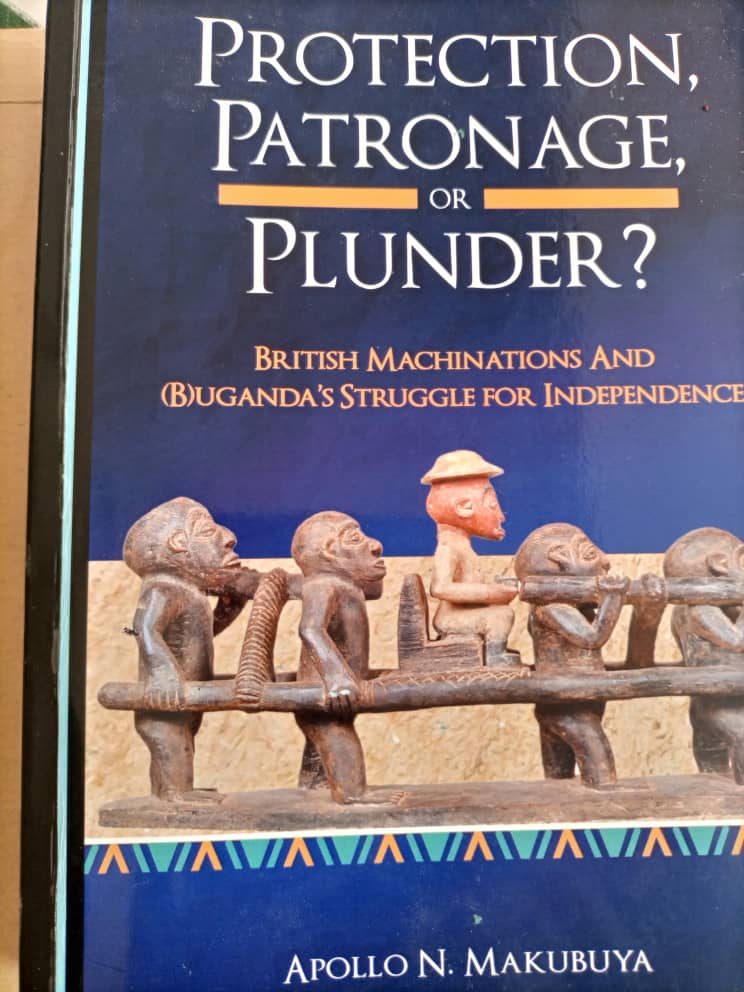
This is a huge book but very essential book that dissects the history of Uganda as a British protectorate for sixty-eight years and beyond. I chose to read it slowly and it took me three months to complete but it was worth the time and effort. What makes it unique is that the writer, a lawyer by profession, had access to declassified records that had been kept under lock and key in UK for over fifty years. Close to our independence in 1962, many historical documents were shredded and burned at the Lugazi Sugar works and others were packed in crates and damped at sea to sanitize the colonial abuses. The safe files were then shipped to UK and kept at a high secret building used by the national security organisations: M15 and M16.
Makubuya has ably used these recently declassified documents as he chronicles the events of the 68 years. Starting from the coming of the first Europeans: Speke and Grant who came looking for the source of the river Nile in 1862. Followed by the Europeans’ Scramble for Africa in early 1885, that created new boundaries which divided ethnicities with no attention to their rich cultural and social bonds. The scramble contributed to the civil conflicts which have lasted up to today. The British wanted to gain control of Uganda mainly to control the source of the river Nile, the lifeblood of Egypt which the British occupied in 1882. They expanded their influence in East Africa and elsewhere to acquire raw materials that could be exploited to fuel the industrial revolution. After colonisation, they concentrated on spreading Christianity, finding new wealth and new trade routes and consolidating their power.
By late 40s, the bataka/clan heads in Buganda had started agitating for control of their land and by 1952 Buganda kingdom, driven by its fear of being included in an East African federation before the clarification of its position in a united Uganda, stood up against the colonial Governor. This culminated in the first exile of King Edward Mutesa 11.
By 1955, the cost of maintaining the empire had become enormous and draining on a Britain that was recovering from the effects of the World War 11. From 1955-1975, a period that came to symbolise the Wind of Change, Britain was forced to let go of the colonies and territories one by one. In the process, the administrators of the Uganda Protectorate hastily put together a group of small states into one Uganda with hardly any negotiations, terms or agreements.
At Independence, the first Prime Minister: Apollo Milton Obote, took over a country loosely held together.
Four years later, the fight for power and control had begun and since then Uganda has been a troubled country. There was a military coup in 1971, a liberation war in 1979, a military coup in July 1985 and a military takeover in January 1986. Uganda has had nine heads of state in the 61 years of Independence.
I have lived through all these post-independence reigns of terror and wars. Our generation considers itself as the Troubled one.
Reading this well researched and thoroughly written history book has helped me understand Uganda’s past clearly. I was able to understand and question some of the decisions taken by those in authority then- the colonial administrators, the collaborating chiefs and the self-interested elites. It is a must-read for all Ugandans from an early age. All aspiring politicians must read it. Understanding our past will free us of it and calls for every well-meaning Ugandan to be responsible, to look at opportunities of using our past to negotiate for a future that embraces us all. We need to do things differently including solving the long standing issues of the Buganda question, land distribution and the effective decentralisation of power.
I cannot wait to read Makubuya’s next big book: THRONES & THORNS.
Kizza Besigye And Uganda’s Unfinished Revolution by Daniel K. Kalinaki

It is about the revolution that was triggered by the need to transform Uganda’s old political order that had enabled the rigging of the 1980 general elections. The Luwero-based guerrilla fighters led by Yoweri Museveni had good intentions of finding a most stable, inclusive political system for Uganda. It was a five year protracted guerrilla war that ended with their defeat of the old order on the 25th January 1986. The fighters promised us a fundamental change in the political, economic and social areas.
Since then, the population has seen some good transformation of the political and economic systems. There have been some bad ones as well; the initial four years in power has been extended indefinitely by the removal of the presidential term limits and age limits. This has created a big gap between the people’s expectations and satisfaction. By the end of 2000, Kizza Besigye was forced by the prevailing circumstances to step up and take action. He offered himself as a presidential candidate, opening up opposition within the originals of the revolution.
The revolution has continued to evolve but from 2001, it has pitted President Yoweri Museveni against Kizza Besigye for the presidency as the government became less democratic, less effective in dealing with and managing society’s concerns and wellbeing.
Some of the original fighters interpreted Besigye’s daring move as “jumping the queue’’ of succession. From 2001 to the general election of 2011, the two fighters hotly contested against each other as Presidential candidates. On each occasion, Besigye and his loyal followers believed that the outcome was a result of the captured systems by an individual. Besigye petitioned the election results of each season in the Supreme court on the basis of rigging, the electoral processing not being free and fair and the violence unleashed on the opposition. The presiding judges agreed on the compromises and malpractices of the electoral process but by a simple majority, they did not consider the flaws big enough to warrant nullifying the results. Having failed to change the government through the vote , Besigye turned to weakening it by leading a campaign of defiance and resistance. The combined power of the military and the Presidency would do whatever it took to contain Besigye.
The country is surely sliding back into inequality and impoverishment. Corruption has become ingrained in all systems and the political patronage has silenced many. Graft has eaten away services and the social fabric.
Sustaining the revolution is becoming increasingly difficult as solutions to the greatest challenges faced by the ordinary people like unemployment, poor education, poor health care services, poor housing and sanitation, poor transport systems and adding value to the majority of the people through economic prosperity and wellbeing is more talk than action.
This is why Besigye as one of the original fighters and among the architects of the Movement’s Ten-Point Political Programme, categorically states that Uganda’s revolution is far from complete.
Kalinaki as an accomplished journalist of the time, did a remarkable job in piecing the story of the revolution and of the two protagonists together. Intellectually stimulating, easy to understand and follow.
Reading Kizza Besigye’s story soon after reading Makubuya’s Protection, Patronage or Plunder,
was a sheer coincidence but it ended up being very beneficial to me. Each book boosts the credibility of the other. In the last chapter of Makubuya’s book he suggests ways of how after understanding our checkered past, turbulent history and being liberated from it, we must all take the responsibility to look out for opportunities and new possibilities to negotiate for our collective future.
Similarly, in the epilogue of Besigye’s book, after going through a litany of arrests, torture, humiliation and defeats while fighting to oppose the system headed by the incumbent President, he clearly points it out that: Uganda’s revolution that begun in 1981, is far from complete.
He knows for sure that this revolution will never progress to completion until pivotal reforms in politics and governance are put in place by all well- meaning Ugandans led by the opposition or movement or both. Readers are left with the responsibility of doing something different for their country.
Failing to do this, like the Medusa head of Greek mythology, our past will keep raising its ugly head into the present; essentially leaving us in the past and influencing our future.
Robert Heinlein rightly said: A generation which ignores history has no past and no future
QUESTION:
What do you have to say about this quote in relation to our prevailing circumstances?

 apagefrommunakusbook