Growing old is a privilege that is not enjoyed by everyone. Having said that, the number of elderly people in the world even in communities of the least developed countries like mine, has continued to rise for decades. World Health Organisation statistics show that in 2022 there were 771 million people aged 65 years and above globally, accounting for almost 10% of the world’s population. This segment of the population is expected to rise to 16 % in 2050.
United Nations defines an elderly person as anyone who is over 60 years of age. WHO regional office for Africa set 50 years as being old age in the Sub- Saharan Africa.
Advances in science and medicine have allowed many people to live longer. As people are living longer, their wellbeing and dignity has to be ensured. As we grow older, we suffer decline in our physical and mental capacities and this results in challenges and opportunities. There is an increased demand for primary health care and long term care.
United Nations declared 2021 -2030 as the decade of healthy aging mainly to bring everyone on board : governments, international agencies, professionals, private sectors and communities to improve the lives of older people , their families and communities. Healthy longevity.
The elderly have to live in dignity and security and be free of exploitation and physical or mental abuse. They should be treated fairly regardless of age. They contributed to the development and growth of their communities and countries during the active part of their lives.
The 5 most crucial rights of the elderly as par the UN guidelines include:
- The right to enjoy human rights and fundamental freedoms
- The right for care
- The right for self-fulfilment
- The right for Dignity – full respect for their beliefs, needs and privacy
- The right to make decisions about their care and the quality of their lives
Due to improvement in health care and hygiene, universal education, improvements in the environment, sufficient food, healthier lifestyles and better economic development, Uganda’s life expectancy has continued to rise from the 50s to date. It has risen from an average of 49.16 years in 1971 to the current 62.9 years for males and 67.2 in females according to the Uganda Bureau of Statistics population projections Reports of 2015-2050.
The HIV/AIDS pandemic of the 80s and 90s had lowered it to 45.72 in 1991, wiping out the gains that had been made since independence.
The 2 year long COVID-19 pandemic killed more people aged 60 and above due to chronic underlying conditions like diabetes, hypertension and cancers.
Since December 1990, 1st October has been celebrated as the UN’s International Day of Older Persons to recognise the contributions of older persons and to examine issues that affect their lives. The theme varies from year to year.
The theme for 2023 was : Fulfilling the Promises of the Universal Declaration of Human Rights for Older Persons : Across Generations.
As early as the 2nd September 2023, my four years old grandchild had invited me to join her celebrate the day of grandparents at her preschool, Inyana International School in Kiwafu, Kansanga. With her reassuringly innocent smile she had indicated that I had to be there on that day. The official invitation from the school came later.
On the Friday, 29th September 2023, I dropped everything to be at Inyana school by 10am. I was simply dressed in an olive-green dress, light green jacket and pair of low-heeled beige shoes.
Amazingly, Nanziri’s paternal grandmother had beaten me to it!
We were warmly received by our grandchildren who looked very much alike in their red T-Shirts over black trousers and black shoes. The teachers were also in red and black.
The grandparents were of all ages and sizes; some were dressed in the colourful African prints, traditional busuti but majority were elegant and vibrant in the modern dresses and suits without neck ties. There were two couples from the Far East.
There were two young couples of my daughter’s age. Later I learned that the grandparents lived far away from Kampala so the parents had chosen to stand in for them. It worked wonders for their children.
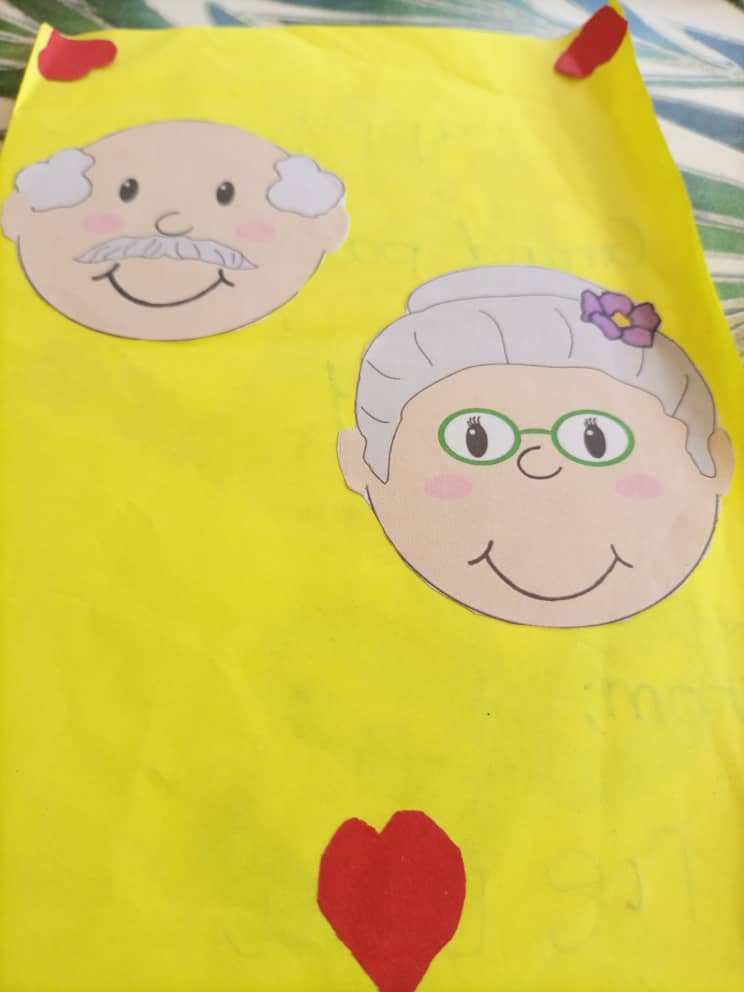
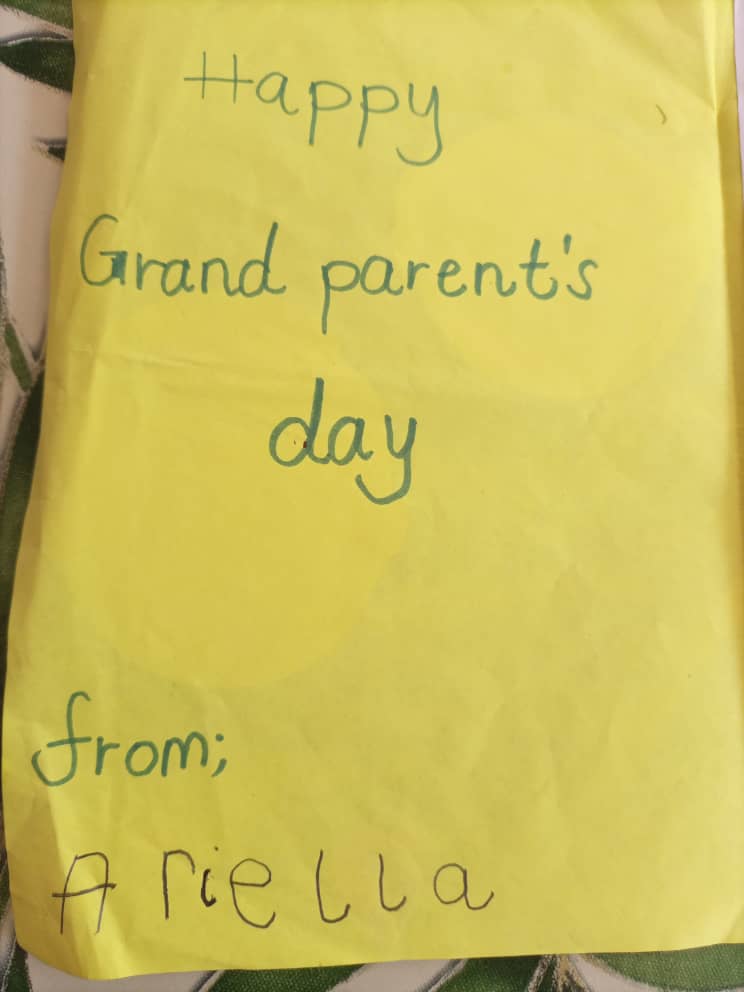
The grandchildren sang songs for us then accompanied us to their different classes to look at their books and creative pictures on the walls. Each guest was given a card put together by the grandchild.
Under the eyes of her teacher, Nanziri was not as spontaneous as she usually is at home.
It drizzled and we sought shelter in those small classes. We squeezed ourselves on
the tiny chairs and desks! It all seemed so long ago since I last sat on such a small – sized chair!
“Something magical happens when parents turn into grandparents.’’– Paul Linden
The school arranged for each student to take three photographs with each of her/his grandparents. These were later sent to us on the parents’ phones.
I remembered I had a few photos of my classmates in Junior school and senior school. Some were taken during the school plays that we used to perform at the end of each year. Over the years I have come to treasure them immensely.
By the time we left at 12:30, a few of the youngest grandchildren were crying for their grandparents and were being calmed down by the class teachers. Nanziri had joined the boys racing big trucks on the floor.
I left the school happy and content for the attention we had been accorded. I was also hopeful for the future as it dawned on me that a part of my history would no doubt form a part of Nanziri’s future.
For over 35 years we had been putting others first: spouses, children but at least for now someone was putting us first.
Back home, something kept nagging me: in the forty visitors at the school the majority of us were women. Not more than three couples had come in as grandfather and grandmother.
What I had noted was not an exception; globally, females tend to outlive the males.
According to the Uganda Bureau of Statistics Population Projections Reports 2015-2050,
those aged 60 and above make up about 3.7% of the population and the majority of these are female.
The few times I have accompanied my mother to collect her monthly Elderly allowance of 25 thousand UGX (6.67 US dollars), a privilege only for those aged 80 and above. They make up 0.4% of the population :81,600 males and 122,400 females.
By simple observation, the majority of these are females even in our communities. This is how it has been since I was growing up in the 60s.
Countries with highest life expectancy at birth in Africa are:
Algeria 77 years, Tunisia 76, Egypt 70 and Senegal 69 compared to Japan’s 84.
Japan is a country with the world’s lowest birth rate(1.26 in 2022) translating in only 771,000 births, and the highest number of older people: 29.1 % are aged 65 and above. 1 in 10 people in Japan is aged 80 or older. The working –age population pay more to support the elderly- costs of health and retirement programs.
Even in this oldest population, 51% are females while 48.7% are males.
Scientific studies have tried to explain the gender difference in life expectancy.
At birth, generally there are slightly more male births than female births- about 105 boys for 100 males. For unknown reasons, the “Y”- chromosome bearing sperm is more likely to fertilise the female egg than the “X’’- chromosome bearing sperm.
The female species has two “ X’’ chromosomes compared to the males one who has “X’’ and “Y’’. The extra X chromosome in the female acts as a genetic reserve when a genetic mutation occurs on one of the genes.
The biological protective effect comes into play from puberty (10-14 in girls and 12-16 in boys). The female species starts producing the female hormones the main one being Oestrogen and will continue until menopause 45-55 years. The male produces the male hormones the main one being testosterone.
Researchers have shown that Oestrogen protects the women from premature heart disease-it lowers the “bad’’ cholesterol, LDL, in the blood which clogs the arteries and results in arterial stiffening. Clogged arteries cause reduced blood flow to the heart and brain causing heart disease and stroke.
On reaching menopause, the ovaries stop producing the female hormones; the oestrogen deficiency causes the risk of cardiovascular disease to increase in women. The women gradually catch up with the males.
3. The social factors affecting longevity.
In most communities, men tend to take up the most dangerous jobs like construction, truck driving, logging, mining, fishing and working in the armed forces. Such jobs increase their risk of early deaths. Generally, men take more risks than the females making them more susceptible to life-threatening injuries.
Lifestyle plays a part, as men tend to smoke more than females and to abuse alcohol and drugs. This increases their risk for heart disease and cancer.
Women are the primary care providers – taking care of children , the sick and the elderly. They visit clinics and hospitals more often than men. They tend to build up information and awareness about diseases resulting in better health seeking behaviour than the men.
Men tend to visit health facilities late for chronic diseases or cancer.
Women tend to form strong social groups in their communities. They share stories and information and build each other up unlike males of their age groups.
Sadly, in Uganda, 228 women die in labour or in pregnancy-related complications per 100,000 live births. However, education and economic empowerment is gradually helping women to control their fertility.
All the elderly in our communities should be treated with respect, dignity and be made to feel that they still matter. Celebrating them often offers them an opportunity to engage actively with the people around them. An inclusive community helps to foster a sense of belonging and acceptance- feeding into the mental and emotional wellbeing of each individual.
“ Nothing is a waste of time if you use the experience wisely.’’- August Rodin
QUESTION :
How often do you take off time to listen actively, connect and share thoughts and experiences with those older than you or younger than you with the aim of fostering understanding between different generations and finding areas of common interest?

 apagefrommunakusbook